About Rupicapra rupicapra (Linnaeus, 1758)
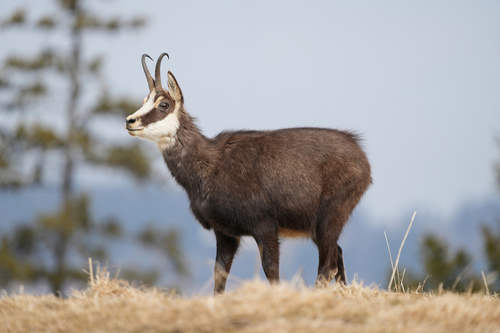
The chamois, Rupicapra rupicapra (Linnaeus, 1758), is a very small bovid species. Fully grown adult chamois reach a shoulder height of 70–80 cm (28–31 in) and have a total body length of 107–137 cm (42–54 in). Males are slightly larger than females: males weigh 30–60 kg (66–132 lb), while females weigh 25–45 kg (55–99 lb). Both sexes have short, mostly straight horns that curve backward into a hook near the tip; male horns are thicker than those of females. In summer, the chamois' fur is a rich brown, and it changes to a light grey during winter. Distinctive features of the species include contrasting white markings on the sides of the head, prominent black stripes running below the eyes, a white rump, and a black stripe along the back. The chamois is native to the Pyrenees, the Alps, the mountain ranges of south and central Europe, Turkey, and the Caucasus. It inhabits steep, rugged, rocky terrain at moderately high elevations that reach at least 3,600 m (11,800 ft). In Europe, chamois spend summer in alpine meadows located above the tree line, and move to lower elevations around 800 m (2,600 ft) to overwinter in pine-dominated forests.