About Rupertia physodes (Douglas) J.W.Grimes
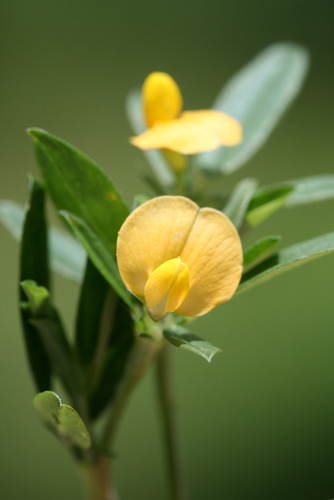
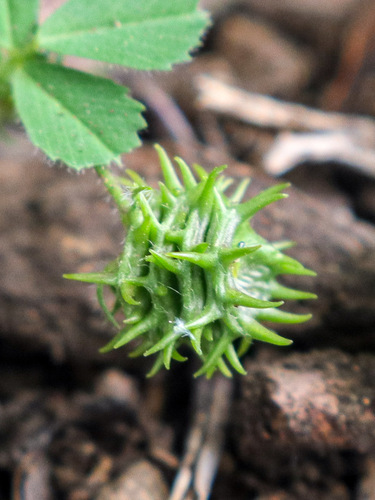
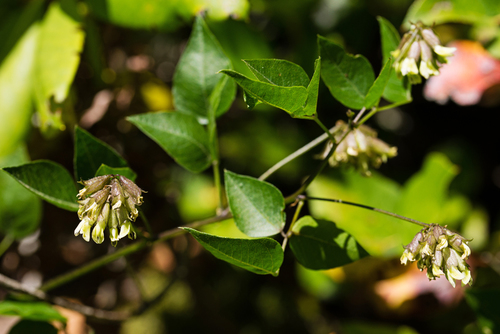
Rupertia physodes is a low, bushy perennial herb. Its branches are often recumbent, and may grow together to form dense ground cover. It has deep, woody roots, and grows well on the dry edges of woodlands and prairies. It flowers in late spring and summer, a time when few other nectar sources are available. Its leaves are trifoliate, with three dark green, tear-shaped entire leaflets. The leaflets are mostly smooth overall, with sparse hair along their veins. Flowers are crowded on an axillary raceme that measures approximately 5 centimeters (2.0 inches) long, and holds 25 to 40 individual flowers. The individual flowers are papilionaceous, or pea-like, in shape. They are white to cream in color, tinged with green or purple when newly opened, and fade to a rusty brown as they age. A key characteristic of this species is that the calyx continues growing after the flower is shed. It quickly becomes much longer than the developing seed pod, forming a large, expanded conical collar around the one-seeded pod. When the pod reaches maturity, it is grayish, one-seeded, tomentulose, and membranaceous. It can be easily rubbed away to reveal the single shiny black reniform seed inside, which measures 5 millimeters (0.2 inches) long. Mature bracts of this species have a light resinous aromatic odor that resembles the scent of hops.