About Rumex occidentalis (Michx.) S.Watson
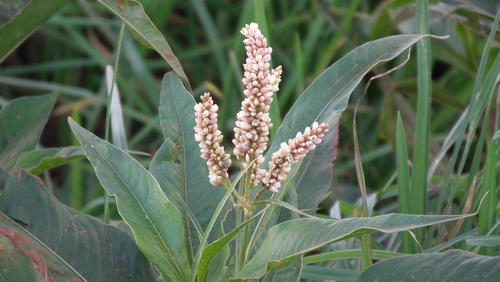
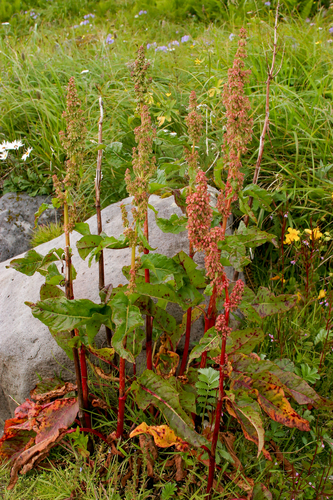
Rumex occidentalis, commonly known as western dock, is a perennial plant that flowers annually and lives for multiple years. Mature western dock plants can grow up to 180 cm (6 feet) tall. At maturity, its leaves are partially persistent; they have a triangular, blade-like shape with a truncate base. The stems are usually erect, and its pedicels are no more than 3 times as long as the inner tepals. This species produces reddish brown achenes, and its flowers grow in whorls of 12 to 25.
Western dock is native to North America. It occurs in western U.S. states including California, Nevada, and Idaho, and has been recorded historically in Washington state. It typically flowers in late spring and summer. It requires moist environments to grow well, and is most often found in marshes, bogs, wet meadows, and other shallow water habitats.
Western dock has both nutritional and medicinal uses. Medicinally, its leaves are used in herbal sweat baths to relieve rheumatic pains. A poultice made from the roots can be applied to treat open wounds, cuts, and boils. Nutritionally, the leaves, stems, and seeds of western dock are all edible. Young leaves are cooked and eaten in a similar way to spinach. Cooked stems are used similarly to rhubarb. Seeds can be eaten raw or cooked, and are commonly ground into powder to use as seasoning or to make gruel. Eating large quantities of western dock, or eating it uncooked, is not recommended because its leaves may contain high levels of oxalic acid.