About Rumex maritimus L.
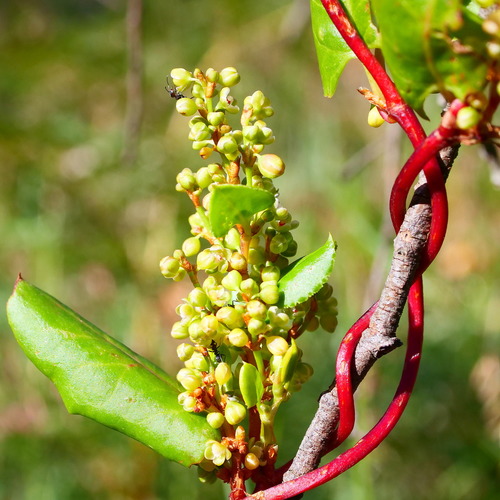
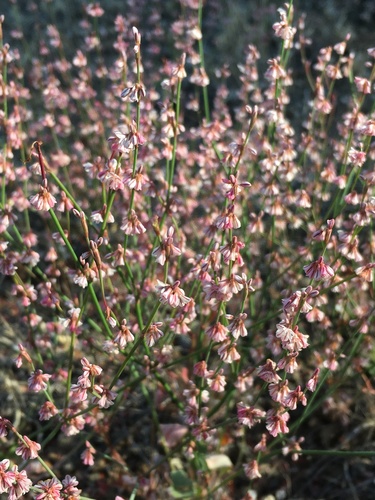
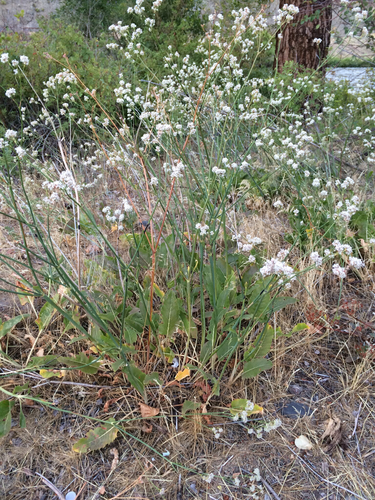
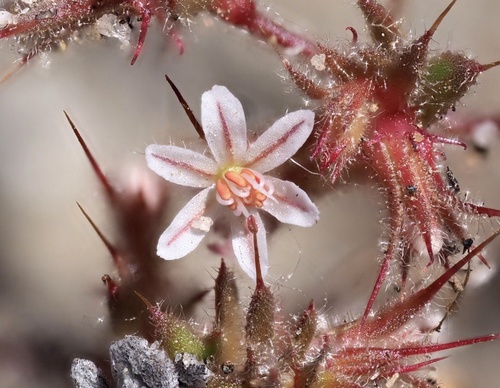
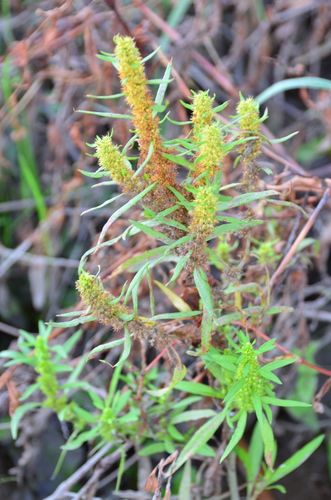
Rumex maritimus L. produces golden yellow or green-yellow inflorescences along its leaves and stem, and grows to between 15 cm and 75 cm tall from its base. Its stems can grow upright or lie prostrate against the ground, and its pedicels range from 3 to 8 cm long. The leaves are wedge-shaped, most often narrow at both ends, and only rarely broadly wedge-shaped. Leaf blades are lanceolate or lanceolate-linear, with overall dimensions ranging from 7 cm long by 1.5 cm wide up to 25 cm long by 4 cm wide. Each flower stalk of Rumex maritimus bears 15 to 30 individual flowers, which are triangular or rhombic-triangular in shape, ranging in size from 2.5 mm wide by 0.75 mm tall to 3 mm wide by 1.2 mm tall. This species is very rare in Ireland, where it has only been recorded in County Cork from around 1870 onward, and it is considered a local species in Britain. In the United States, the U.S. federal government lists this species (called seaside dock in Connecticut) as a species of special conservation concern, and lists the golden dock population in New York as endangered. The U.S. federal government also classifies this Rumex species as a noxious weed. Rumex maritimus grows most often in areas that experience periodic flooding. Elongated shoots develop during mid-summer or the general summer season. Non-elongated shoots reproduce during the flooding season, as flood water carries the plant's seeds to new locations. Most parts of Rumex maritimus are used for medicinal purposes. Its seeds are used as an aphrodisiac, a sex stimulant. Its leaves are used to treat external burns and ringworm, and its roots are used to treat skin diseases. This plant is also used as food: its seeds can be ground into powder to make porridge, and its leaves can be cooked and eaten as a vegetable.