About Ruditapes decussatus (Linnaeus, 1758)
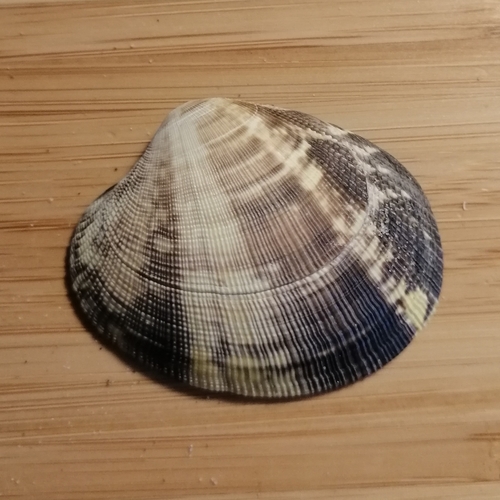
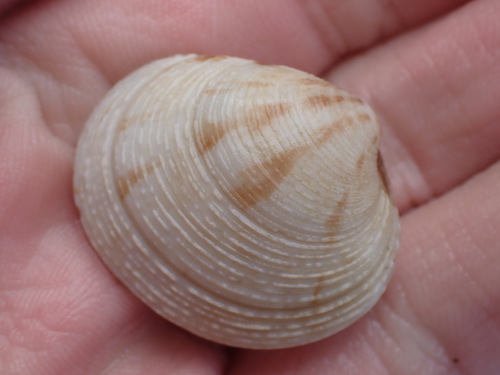
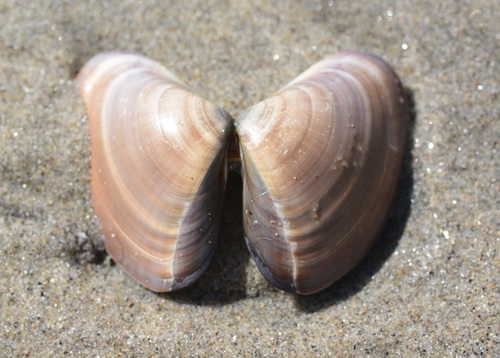
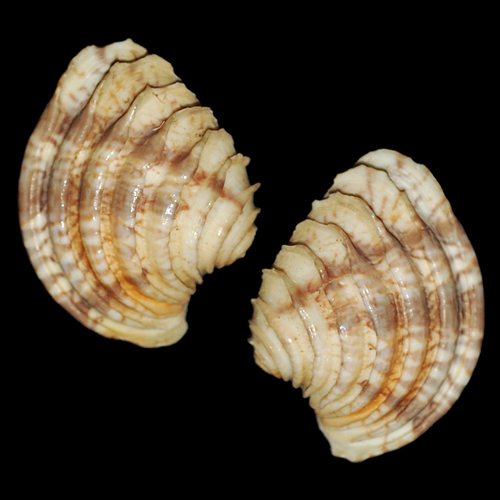
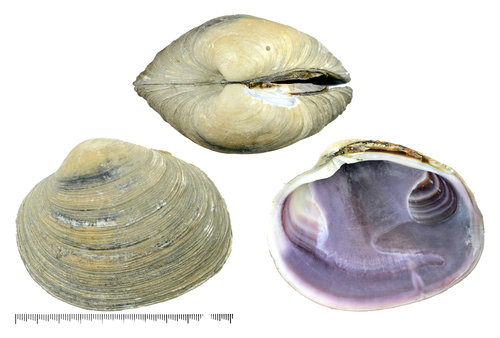
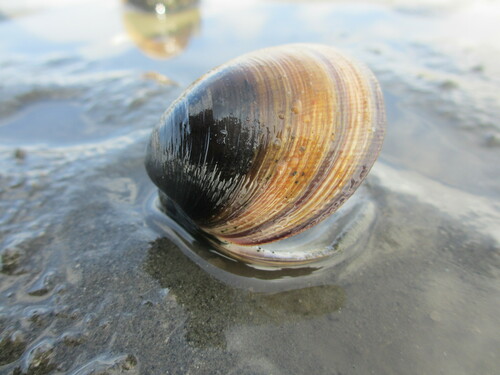
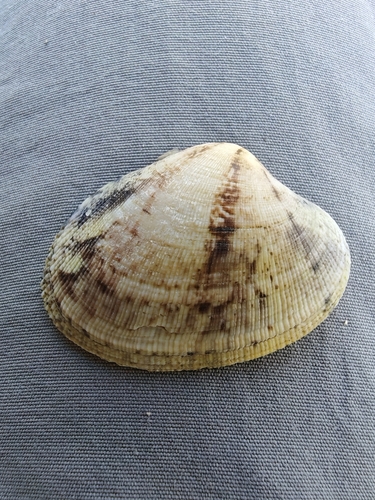
This species is scientifically named Ruditapes decussatus (Linnaeus, 1758). Its shell ranges from broadly oval to quadrate in shape, with umbones positioned distinctly toward the anterior end. The posterior hinge line is straight, the posterior margin is truncate, and the anterior hinge line transitions smoothly into the down-sloping anterior margin. The shell is prominent at the posterior end, where it is conspicuously decussate. The shell surface has a sculpture of fine concentric striae and bolder radiating lines, and its growth stages are clearly visible. Both the lunule and escutcheon are poorly defined. Each valve holds three cardinal teeth: the central tooth on the left valve, and the central and posterior teeth on the right valve are bifid. The pallial line and adductor scars are distinct. The pallial sinus is U-shaped, does not extend beyond the shell’s midline, and reaches a point below the posterior portion of the ligament. The lower limb of the sinus remains distinct from the pallial line along its entire length. The inner surfaces of the shell are glossy white, often with yellow or orange tints, and carry a bluish tint along the dorsal edge. The overall outer color of the shell is cream, yellowish, or light brown, and often has darker markings. Ruditapes decussatus is cultured along the Atlantic coasts of France, Spain, and Portugal, and throughout the Mediterranean basin. It is frequently cultivated alongside other bivalve species: Venerupis pullastra, Venerupis rhomboides, Venerupis aurea, Dosinia exoleta, and Tellina incarnata. The main predators of Ruditapes decussatus are shore crabs (Carcinus maenas), starfish (Asterias rubens and Marthasterias glacialis), gastropods of the genus Natica, and gulls (Larus sp.). A single 6.5 cm wide Carcinus maenas can consume 5 to 6 of these clams per day. In 2003, marine aquaculture production of grooved carpet shell (Ruditapes decussatus) in Portugal reached 3,007 tonnes; this figure does not include non-aquaculture harvesting of the species. Between 1997 and 2001, total global aquaculture production of the species ranged from 3,700 to 4,900 tonnes across five producing countries. Portugal produced most of this total, though France and Spain were also significant producers. France’s contribution to global production is now much lower than in previous years: in 1995, France was by far the leading producer with nearly 5,200 tonnes, but by 2004 it produced only 475 tonnes. Global aquaculture production of the species appears to be declining. In 2004, total global production was only 2,700 tonnes, and the United Kingdom had emerged as a minor producer. Ruditapes decussatus is consumed both fresh and canned.