About Rudbeckia triloba L.
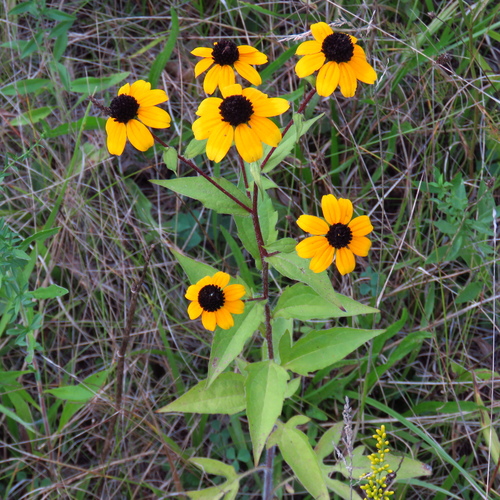
Rudbeckia triloba L. is a biennial or short-lived perennial herbaceous plant. It reaches a maximum height of 5 ft (150 cm) and can grow up to 2.5 ft (75 cm) wide. Its main stem produces many branches, creating an open, bushy growth form. Stems and branches are covered in hairs, are medium green, and sometimes develop a reddish tint. All leaves are also hairy. Its basal leaves have three lobes, which is the origin of the Latin specific epithet triloba. Stem leaves grow in an alternate arrangement, and their shape varies along the plant: three-lobed leaves are generally found lower on the main stem, while unlobed leaves occur higher on the central stem and on secondary branches. Three-lobed stem leaves grow up to 7 in (18 cm) long and 4 in (10 cm) wide, while unlobed leaves reach a maximum of 3 in (8 cm) long and 1 in (3 cm) wide. One or two flower heads, each 0.5–1.5 in (1–4 cm) across, grow at the tips of individual upper stems. Each flower head holds six to twelve bright yellow ray florets that surround a flattened, purplish brown cone of disk florets. Flower heads are abundant and showy, but they produce little to no scent. This species is native to the United States, where its range extends west to Utah, south to Texas and Florida, north to Minnesota, and east to Massachusetts. It grows in a variety of habitats including disturbed ground, woodland borders, thickets, rocky slopes, and the verges of roads and railways. R. triloba is widely cultivated in gardens, and it is easy to grow when planted in full sun with moist soil. Regular deadheading is recommended to encourage additional blooming, prevent unwanted self-seeding, or both. In UK cultivation, Rudbeckia triloba has been awarded the Royal Horticultural Society's Award of Garden Merit.