About Rucervus duvaucelii (G.Cuvier, 1823)
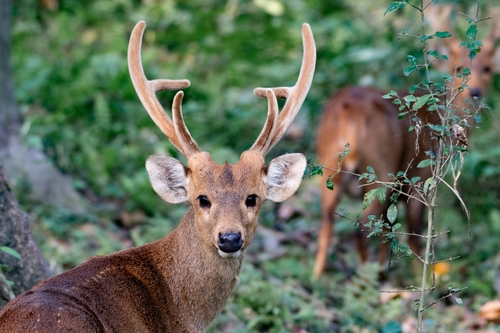
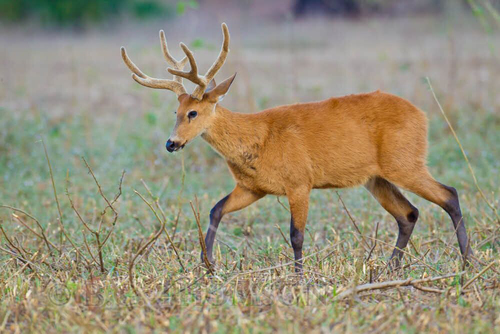
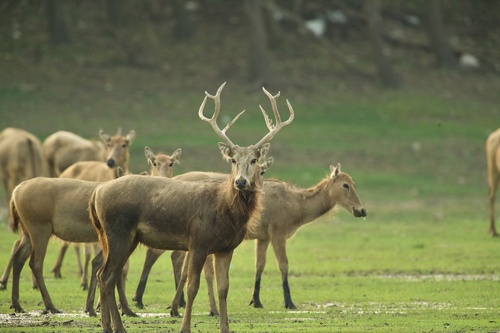
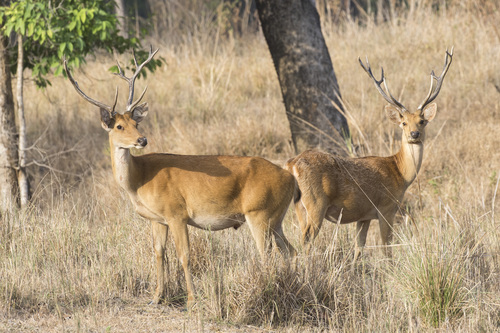
Barasingha, also called swamp deer with the scientific name Rucervus duvaucelii, is a large deer species. Its shoulder height ranges from 44 to 46 inches (110 to 120 cm), and its head-to-body length reaches nearly 6 feet (180 cm). Its coat is rather woolly, yellowish brown on the upper body and paler on the underparts, with white spots along the spine. The throat, belly, inner thighs and area beneath the tail are white. In summer, the coat shifts to a bright rufous-brown color. Males have a maned neck; females have paler coloration than males, and young individuals have spotted coats. On average, barasingha antlers measure 30 inches (76 cm) along the curve, with a 5-inch (13 cm) girth at the mid beam. The record antler measured 104.1 cm (41.0 inches) along the curve. Stags weigh 170 to 280 kg (370 to 620 lb), while lighter females weigh around 130 to 145 kg (287 to 320 lb). Large stags have been recorded weighing 210 to 260 kg (460 to 570 lb). Before the 19th century, barasingha were common across many areas, including parts of the Upper Narmada Valley and southern Bastar. They inhabit flat or undulating grasslands, floodplains, and marshes, and typically stay on the outskirts of forests; they can also sometimes be found in open forest. In the 1960s, the total population was estimated at 1,600 to 2,150 individuals in India, with around 1,600 more in Nepal. Today, the species' distribution is further reduced and fragmented, following major population losses between the 1930s and 1960s caused by unregulated hunting and conversion of large areas of its habitat to cropland. In Nepal, barasingha are primarily found in the country's western regions south of the Himalayas, in Shuklaphanta and Bardiya National Parks. Within India, barasingha occur in six localities in Uttar Pradesh, in Kanha National Park in Madhya Pradesh, and have been observed just across the state border in Chhattisgarh near Dhamtari, which is likely the species' most southerly distribution extent. The species is regionally extinct in West Bengal, and is likely extirpated from Arunachal Pradesh, Bihar, Jharkhand, Meghalaya, Nagaland and Odisha. A small number of barasingha still survive in Assam's Kaziranga and Manas National Parks. In 2005, a small population of around 320 individuals was discovered in Jhilmil Jheel Conservation Reserve in Haridwar district, Uttarakhand, on the east bank of the Ganges; this is likely the most northerly limit of the species. Three subspecies of Rucervus duvaucelii are currently recognized. The nominate subspecies Western swamp deer, R. d. duvauceli, is the most abundant. This water-loving deer has splayed hooves and is adapted to the flooded grassland habitat of the Indo-Gangetic Plain. In the early 1990s, the Indian population was estimated at 1,500–2,000 individuals, and Nepal's Shuklaphanta Wildlife Reserve held 1,500–1,900 individuals; the Shuklaphanta population reached 2,170 individuals including 385 fawns in spring 2013. Southern swamp deer, also called hard ground swamp deer, R. d. branderi, has hard hooves and is adapted to hard ground in open sal forest with grass understorey. It survives only in Kanha National Park, west of Chhattisgarh and east of Madhya Pradesh. It was reintroduced to Satpura Tiger Reserve. The population numbered around 500 individuals in 1988, an estimated 300–350 individuals at the turn of the 21st century, and 750 individuals in 2016. Eastern swamp deer R. d. ranjitsinhi occurs only in Assam; the population numbered around 700 individuals in 1978, and an estimated 400–500 individuals were in Kaziranga National Park at the turn of the 21st century. After a 2021 census, 868 individuals were estimated in Kaziranga, with an additional 121 in Manas National Park. Barasingha are mainly grazers, feeding largely on grasses and aquatic plants, most commonly Saccharum, Imperata cylindrica, Narenga porphyrocoma, Phragmites karka, Oryza rufipogon, Hygroryza and Hydrilla. They feed throughout the day, with feeding peaks in the mornings and late afternoons through evenings. In winter and monsoon seasons, they drink water twice a day, and drink three or more times a day in summer. During the hot season, they rest in the shade of trees during the day. In central India, herds average 8–20 individuals, and can reach up to 60 individuals. Herds contain twice as many females as males. During the rutting season, adult barasingha form large herds. The breeding season lasts from September to April. Births occur after a 240–250 day gestation, between August and November, with a peak in September and October in Kanha National Park. Barasingha give birth to single calves. When alarmed, they produce shrill, baying alarm calls. Compared to other deer species, barasingha are less vigilant while grazing: they keep fewer sentries and spend most of their time grazing, unlike species such as spotted deer or sambar deer.