About Rubus tricolor Focke
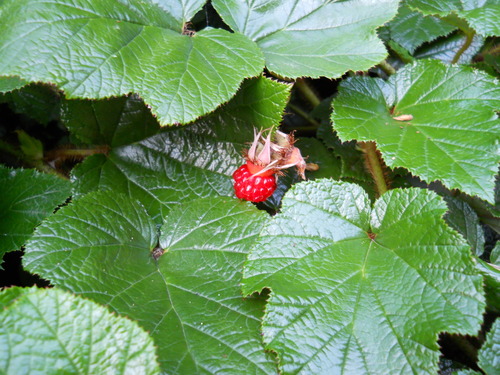
Rubus tricolor Focke has a growth habit that is both prostrate or procumbent, trailing along the ground, and climbing. It is most often described as an evergreen shrub, though sources also call it semi-evergreen or deciduous. This variation occurs because it is typically evergreen, but will drop its leaves during severe winters. Its long stems grow to between 30 and 60 cm (12 and 24 inches) high when arching, and it may grow taller when growing over itself or other shrubs. Stem tips root when they contact the ground. It grows quickly, spreading up to 2 m (6 ft 7 in) each year, and typically forms a dense creeping mat made of interconnected sprawling shrubs. Its stems are tomentose, covered in dense yellow-brown bristles, and do not have prickles. Leaf petioles measure 1.5–4 cm long, and are similarly bristled with glandular hairs; they also bear persistent stipules that are approximately 1–2 cm by 4–8 mm in size. Leaves grow in an alternate arrangement, with each leaf emerging from a different node. Leaf blades are either simple and undivided, or slightly undulate with 3 to 5 shallow lobes, shaped ovate to oblong, with a subrounded to cordate base and a shortly acuminate apex. In simpler terms, leaves have a heart-shaped base and a pointed tip. Leaf margins are described as unevenly, coarsely and sharply serrate. Leaves measure approximately 6–12 cm long by 3–8 cm wide. The abaxial (lower) leaf surface is yellow-grey, covered in bristles that are especially prominent along the raised leaf veins. The adaxial (upper) leaf surface is dark green, glossy, mostly glabrous (hairless), with only sparse bristles between the veins. Its flowers are white, around 2.5 cm wide, and grow either singly or in small clusters. The fruit is an aggregate of drupelets, bright red, subglobose (imperfectly rounded), and 1.5–1.7 cm in diameter. It is native to Sichuan and Yunnan provinces in southwest China, and has been introduced to Great Britain and Ireland. In its native range, it grows on steep banks and slopes, within forests, thickets, and mountain scrub, at elevations between 1,800 and 3,600 m (5,900 and 11,800 ft) above sea level. R. tricolor is a tough, easily cultivated, low maintenance plant. It is cold hardy to around −15 °C (5 °F), so it can be grown in United States Department of Agriculture (USDA) hardiness zones 6–9, and holds a Royal Horticultural Society hardiness rating of H5. It grows in well-drained soil, and tolerates moist soil as long as drainage remains reasonably good. It can grow in a variety of soil types including chalky and sandy soils, and tolerates acid, neutral, or alkaline soils, though it prefers loam. It grows best in partial shade, but also tolerates deep shade or full sun. It is widely used as a groundcover to suppress weeds and protect soil. Because it is very vigorous and fast-growing, it is better suited for larger areas, and considered too vigorous for small gardens. Due to its tolerance of deep shade and production of edible fruit, proponents of forest gardening recommend it as a good groundcover for growing under trees. Even though it forms a dense groundcover, prolific seeding tree species such as ash (Fraxinus excelsior), sycamore (Acer pseudoplatanus), and elder (Sambucus nigra) will still invade it when no canopy layer is present. Some gardeners advise against planting R. tricolor with any plants smaller than trees, as it tends to smother smaller plants. Propagation is most often done via tip layering in July, softwood cuttings in summer, or hardwood cuttings in winter. Plant division is usually completed in early spring. Seeds require stratification to simulate exposure to cold weather and trigger germination. One recommendation is to sow seeds in early autumn in a cold frame. Stored seed is sown early in the year in a cold frame; if sown later than February, seeds receive 1 month of stratification at 3 °C (37 °F). The hybrid cultivar Rubus x 'Betty Ashburner' is a cross between Rubus tricolor and Rubus calycinoides, and is sometimes called Creeping Raspberry, a common name also used for several other Rubus species including both parent species of the hybrid. The fruits are edible raw or cooked, and are generally handled the same way as raspberries. They are most often eaten raw, as they have a short shelf life after harvesting. Fruit can also be made into jam. A purple-blue dye can be produced from the fruit. Its flowers also provide forage for bees.