About Rubus saxatilis L.
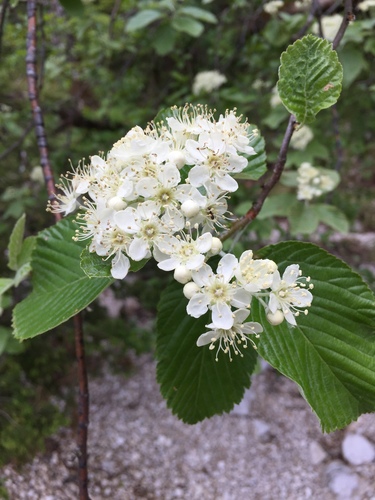
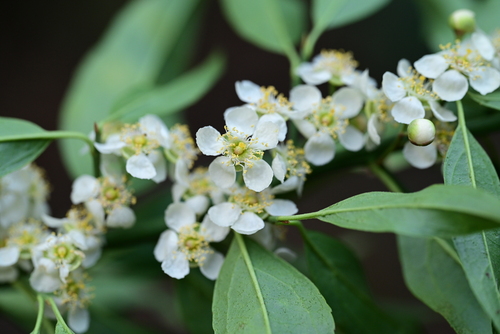
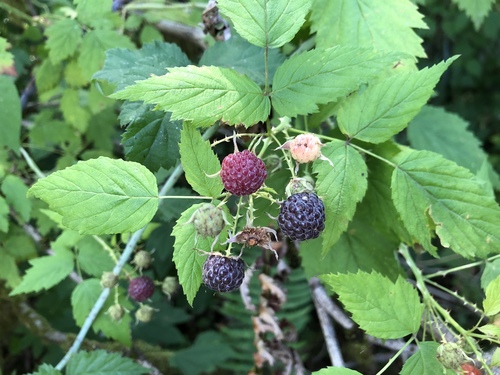
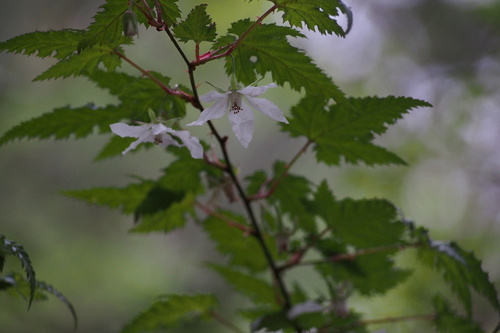
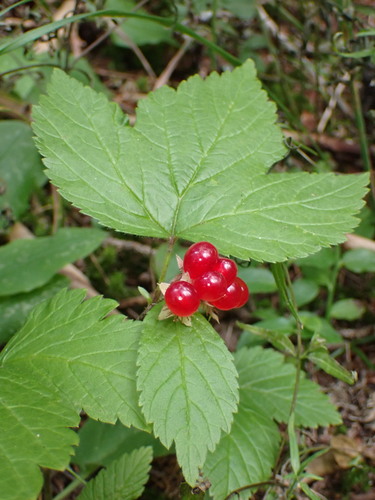
Rubus saxatilis L., commonly called stone bramble, is a perennial plant with biennial stems that die after fruiting in their second year. It produces long runners that root at the tip to grow new individual plants. Its stems reach 20 to 60 centimeters (8 to 23 and 1/2 inches) tall, are rough in texture, and covered in many small spines. Its alternate leaves are stalked, usually compound, and made up of three oval leaflets with serrated margins. The terminal leaflet has a short stalk, and the two other leaflets are slightly smaller. The inflorescence is a small few-flowered corymb. Each flower has a calyx with five sepals, and a corolla made up of five narrow white petals. Each flower contains a cluster of stamens and several pistils. The fruit is an aggregate of multiple red, fleshy drupes. The full fruit is red, measures 1 to 1.5 centimeters (3/8 to 5/8 of an inch) in diameter, and contains large pips. On average, its fruit persists for 17.6 days, and holds an average of 2.0 seeds per fruit. Fruits are on average 94.0% water, which may be the highest water content among European fleshy fruits. The dry weight of stone bramble fruit is 29.8% carbohydrates and 1.4% lipids. This species is widespread across Europe and Asia, ranging from Iceland and Spain eastward to China, and it has also been found in Greenland. Stone bramble can form dense clumps by spreading via its runners, and it can also spread by seed. Its edible fruit is eaten by birds, which deposit the seeds in new locations through their droppings. It grows well in damp woods and rough areas, and can grow vigorously in clearings created by tree felling. Many parts of the stone bramble plant are astringent, largely due to the presence of tannins. Historically, a root decoction was used in India to treat relaxed bowels, dysentery, and the spasmodic stage of whooping cough. A leaf decoction was used to treat dysentery and some types of bleeding.