About Rubus pubescens Raf.
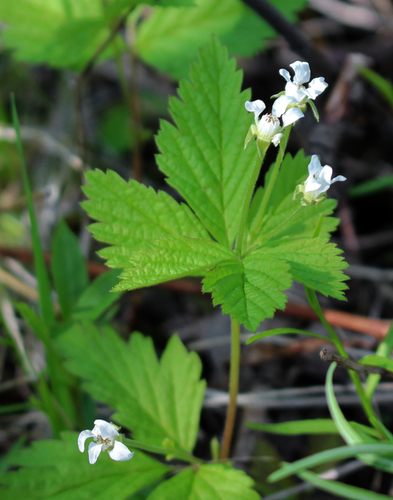
Rubus pubescens Raf., commonly called dewberry, is a subshrub or herbaceous perennial. It produces trailing stems called stolons that grow 10 to 30 cm (4 to 12 inches) long, while its upright petioles are usually less than 20 cm (8 inches) tall. This species differs from larger shrubby Rubus species because its only upright growth is herbaceous, lightly covered in fine hairs (the origin of its specific epithet pubescens), unlike many other Rubus species that have woody stems covered in large prickles. Its leaves are compound, holding three mostly stalkless, diamond-shaped leaflets. The middle leaflet is the largest and most symmetrical, while the two side leaflets are wider below their midrib. All leaflets have toothed margins. All parts of the plant except the trailing stems are shed each autumn. Its flowers have five white petals that are often curled backwards, and yellowish anthers create a yellow and black speckled appearance at the flower center. Flowering typically occurs between late May and late June depending on location, though occasional flowers may appear from early May through August. Flowers usually produce a single shiny red fruit, made up of a cluster of small drupelets attached to a central receptacle, that ripens in early July. Like blackberries, the fruit does not separate easily from its receptacle. Dewberry grows in moist conifer or mixed-wood forests with canopies dominated by spruce and fir, and smaller amounts of aspen, maple, birch, or pine. It roots primarily in the organic layer of soil, and is often found growing alongside bunchberry (Cornus canadensis), wild lily of the valley (Maianthemum canadense), and goldthread (Coptis trifolia). It is most common in boreal and temperate forests of Canada and the United States, with a wide distribution across both north-south and east-west ranges, occurring from montane to coastal elevations and from the Arctic to the Great Plains. A wide range of mammals and birds eat dewberry, including black and grizzly bears, many small rodents, and game birds such as grouse. Its shallow rooting habit makes dewberry susceptible to fire damage, but it spreads quickly across an area via rhizomes. It can become a major component of ground cover after low to moderate-intensity disturbance, reducing soil water loss through evaporation. Like other Rubus species, dewberry is pollinated by insects. Without insect pollination, the number of fruits produced and the number of drupelets per fruit can drop by 85 to 95%. Because it flowers early, it may act as an important food source for pollinating insects in late spring, before more nutritious, abundantly flowering plants such as red raspberry or blueberry crops become available. The fruits are sweet and juicy when eaten fresh from the plant, and can also be used in jams, jellies, and most recipes that call for red raspberries. The receptacle can be eaten along with the berry. Although dewberry fruits are often too scattered and small to be a major traditional food for North American aboriginal groups, groups in the southern and eastern parts of the continent used the plant's roots medicinally. Roots were used to relieve various stomach ailments, and to treat women experiencing issues related to pregnancy or menstruation.