About Rubus pinnatus Willd.
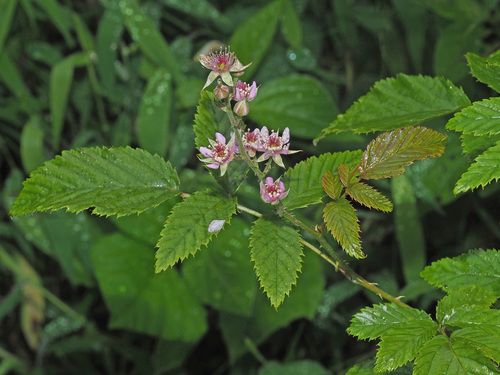
This entry originally lists the scientific name as Rubus pinnatus Willd., but the description provided covers Rubus niveus. Rubus niveus is a shrub that reaches a height of 1 to 2.5 meters (3 feet 3.4 inches to 8 feet 2.4 inches). Its stems are whitish and covered in dense, short matted hairs (tomentose) when young, later become hairless (glabrous) and turn green to purple. The leaves are pinnate, with 5 to 11 leaflets, most often 7 or 9. Individual leaflets measure 2.5 to 8 cm long and 1 to 4 cm wide; they are dark green on the upper surface, and densely covered in pale grey to white tomentose hairs on the lower surface. Flowers are approximately 1 cm in diameter, with five dark pink to red petals. The fruit is 8 to 12 mm in diameter, with a dense covering of grey tomentose hairs. Fruits are dark red when unripe and ripen to black. It is native to southern Asia. Its native range extends from Afghanistan east through India (including Assam, East Himalaya, Nepal, Pakistan, Sri Lanka, and West Himalaya), across to Tibet, southern and north central China, and Taiwan. It also ranges south into Indo-China (Laos, Myanmar, Thailand and Vietnam) and reaches Malesia, where it occurs in Java. It has been introduced to many countries and regions: South America (Bolivia, southern Brazil, Ecuador, El Salvador, Guatemala, Nicaragua, Trinidad and Tobago), the United States (Florida and Hawaii), Africa (Ethiopia, Galápagos, Kenya, Malawi, Tanzania, Zambia and Zimbabwe), and South Africa (Cape Provinces, Northern Provinces and Swaziland). It has become naturalized and invasive in Hawaii and the Galápagos Islands. Rubus niveus is cultivated for its edible fruit. According to Pancholi & Rana 2020, its berries have gastroprotective, antioxidant, and nutraceutical properties.