About Rubus pascuus L.H.Bailey
Rubus pascuus L.H.Bailey produces coarse, woody canes that are typically 2 to 5 meters long. These canes are heavily armed with strong, flattened prickles that are sometimes recurved. The plant's stems are differentiated into two types: first-year stems, called primocanes, which do not usually produce flowers or fruit, and second-year stems, called floricanes, which produce flowers and fruit. Strong, recurved prickles also cover the underside of the leaves and the stems of the plant's flowering and fruiting structure, the raceme. All stems are covered in short, fine grayish hairs, making them canescent.
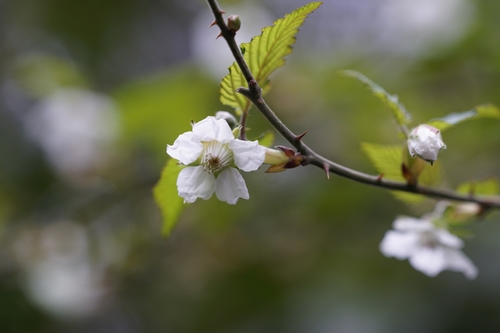
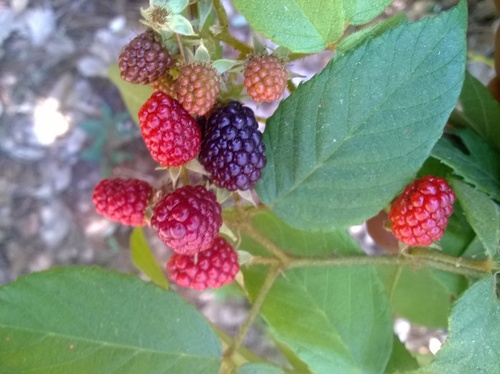
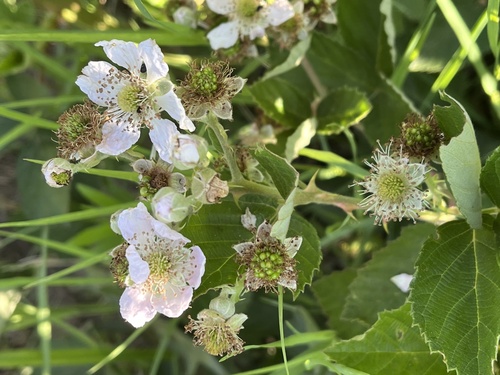
Flower petals of Rubus pascuus range from white to pale pink. As the fruits ripen, they change color from green to red, and finally to dark purple or black when fully mature. Like typical blackberries, the fruit detaches with the receptacle (the tip of the stem) still inside it. This differs from raspberries, where the fruit separates cleanly from the receptacle, leaving a concave hollow inside the fruit. The ripe fruits are edible, and their flavor matches that of other common blackberries.
Most leaves of this species are compound and trifoliate, meaning they are made up of three leaflets. The central leaflet grows on a short stalk (rachis), while the two side leaflets are sessile, attaching directly to the main leaf stalk (petiole). Leaflets are generally ovate-oblong (oval-shaped), with slightly tapering, sharply pointed (acute) tips. Leaf margins have small, irregular coarsely double-serrate teeth. The side leaflets on primocanes are occasionally slightly lobed. The underside of the leaves is a pale bright grayish color and covered in fine hairs, making it tomentose. This distinct pale whitish leaf underside distinguishes Rubus pascuus from similar species that also have recurved prickles, such as Rubus argutus.