About Rubus chamaemorus L.
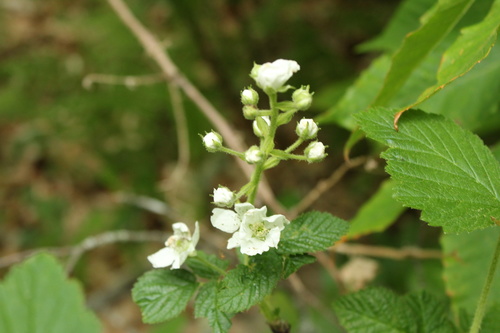
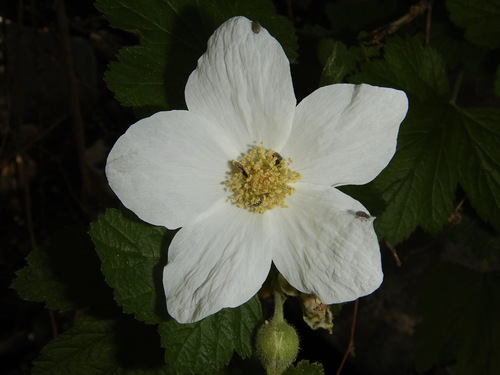
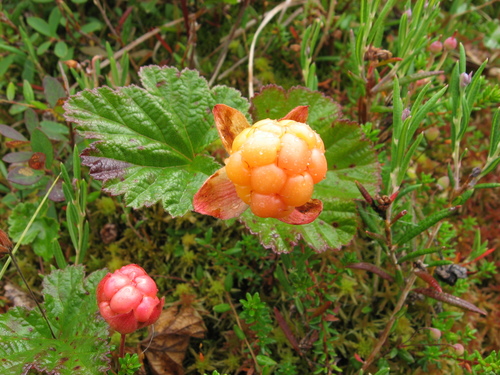
Unlike most species in the Rubus genus, cloudberry (Rubus chamaemorus L.) is dioecious: female plants can only produce fruit after receiving pollination from male plants. This plant germinates from seeds that have been spread by animals that ate its fruit, and then reproduces locally through rhizomes. Vegetative growth can cover a large area, with rhizomes growing 10 meters (33 feet) or longer in length. Mature cloudberry plants grow to a height of 10–25 centimeters (4–10 inches). They have short, unbranched stems that bear 1 to 3 leaves. Each leaf has five to seven palmate (hand-shaped) lobes. After pollination, white flowers that sometimes have reddish tips develop into aggregate fruits that are the size of raspberries, with more fruit produced in wooded habitats than in sun-exposed habitats. Each fruit is made up of between five and 25 drupelets, and is initially pale red, ripening to an amber color in early autumn. After pollination, the flower sepals close around the developing fruit and reopen once the fruit is ripe. Cloudberry is a circumpolar boreal plant that grows naturally across the Northern Hemisphere, ranging from 78°N south to around 55°N, with scattered populations reaching as far south as 44°N, mainly in mountainous areas and moorlands. In Europe, it grows in the Nordic countries, but is rare in the Baltic states (Estonia, Latvia, and Lithuania) and Poland. It is found in the English Pennines and the Scottish Highlands, and there is a single, fragile population in the Sperrin Mountains of Northern Ireland. It grows across northern Russia east to the Pacific Ocean, reaching as far south as the island of Hokkaido, Japan. In North America, it grows wild across Greenland, most of northern Canada, Alaska, northern Minnesota, New Hampshire, Maine, and New York. Its wide natural distribution happens because birds and mammals excrete its indigestible seeds, and rhizomes (which grow up to 10 m (33 ft) long, 10–15 cm (4–6 in) below the soil surface) spread it further and form large, dense berry patches. Cuttings of these rhizomes taken in May or August successfully grow into genetic clones of the parent plant. Cloudberry grows in bogs, marshes, wet meadows, and tundra, and can be found at elevations up to 1,743 m (5,719 ft) above sea level in Norway. It requires acidic soil with a pH between 3.5 and 5.0. In ecology, cloudberry leaves are a food source for caterpillars of several Lepidoptera species. The larvae of the moth Coleophora thulea have no other known food plants. As it is primarily a tundra species, cloudberry grows mostly in the wild and is not cultivated on a commercial scale. In northern Alberta, agriculture, energy development, and other industrial activity reduce the amount of suitable habitat for cloudberry. When ripe, cloudberry fruits are golden-yellow, soft, and juicy, and rich in vitamin C. Fresh ripe cloudberries have a distinctive tart flavor. They are commonly processed into jams, juices, tarts, and liqueurs. In Finland, the berries are eaten with heated leipäjuusto, a local cheese whose name translates to "bread-cheese", as well as with cream and sugar. In Sweden, cloudberries (called hjortron, also known as snattren in northern Sweden) and cloudberry jam are used as a topping for ice cream, pancakes, and waffles, and cloudberry-flavored filmjölk (soured milk) is sold in Swedish supermarkets. In Norway, cloudberries are often mixed with whipped cream and sugar to make a dessert called moltekrem (cloudberry cream), used to make jam, or added to homemade ice cream, and cloudberry yoghurt (called molte- or multeyoughurt) is a supermarket item there. In Newfoundland and Labrador, Canada, cloudberries are used to make bakeapple pie, jams, jellies, fruit wines, and toppings for cheesecakes and ice cream. Arctic Yup'ik and Inupiat people mix the berries with seal oil, diced reindeer or caribou fat (fluffed with seal oil), and sugar to make akutaq, also called "Eskimo ice cream", with recipes varying by region. Along the Yukon and Kuskokwim River areas, recipes include white fish (pike), shortening, and sugar. The berries are an important traditional food resource for Indigenous peoples in the Arctic, including the Yup'ik, Inuit, and Sami. Both Nordic seafarers and Northern Indigenous peoples value the berry for its high vitamin C content. Cloudberries can be preserved in their own juice without added sugar if stored in cool conditions.