About Rubus canadensis L.
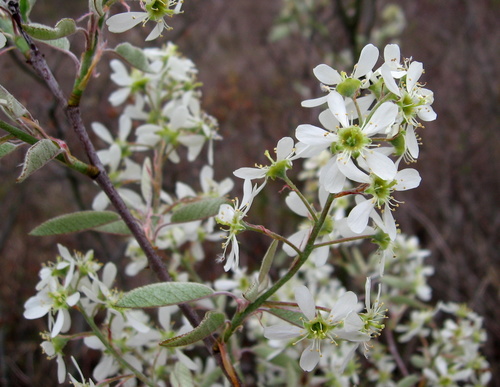
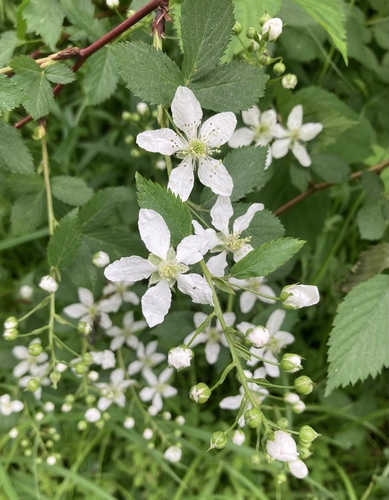
Rubus canadensis, scientifically named Rubus canadensis L., is a North American flowering plant species belonging to the rose family. It is commonly known by multiple common names: smooth blackberry, Canadian blackberry, thornless blackberry, and smooth highbush blackberry. This species is native to central and eastern Canada, ranging from Newfoundland to Ontario, and to the eastern United States, including New England, the Great Lakes region, and the Appalachian Mountains. It has also been recorded rarely in Great Britain, where it is often confused with many other native blackberry species. This rhizomatous shrub grows into thickets that reach 2 to 3 meters (6.6 to 9.8 ft) in height. Its leaves are deciduous and arranged alternately, with each leaf measuring 10 to 20 centimeters (3.9 to 7.9 inches) long. The inflorescence is a cluster that can hold up to 25 flowers. Its fruit is an aggregate structure made of many small drupes, each containing a tiny nutlet. The plant can reproduce via three methods: by seed, by sprouting new growth from its rhizome, and by layering. Its stems can grow one meter (39 inches) in height in less than two months. Rubus canadensis grows in many types of forested habitat, as well as on disturbed sites. Its common associated plants include mountain maple (Acer spicatum), serviceberry (Amelanchier spp.), hobblebush (Viburnum alnifolium), scarlet elder (Sambucus pubens), common blackberry (Rubus allegheniensis), beaked hazel (Corylus cornuta), southern mountain cranberry (Vaccinium erythrocarpum), minnie-bush (Menziesia pilosa), and rosebay (Rhododendron catawbiense). Many types of wild animals feed on the fruits and foliage of this shrub, and its thickets provide cover and nesting sites for animals. Historically, the fruits of this plant served as food for Native American groups, who also sometimes used parts of the plant for medicinal purposes.