About Rubus armeniacus Focke
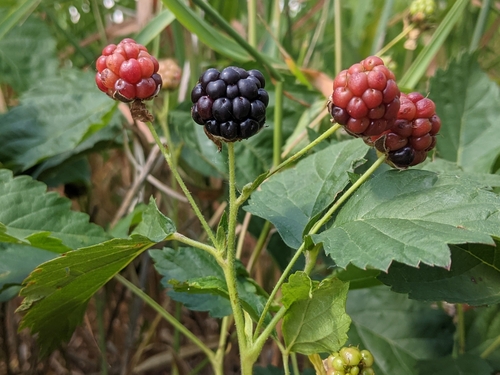
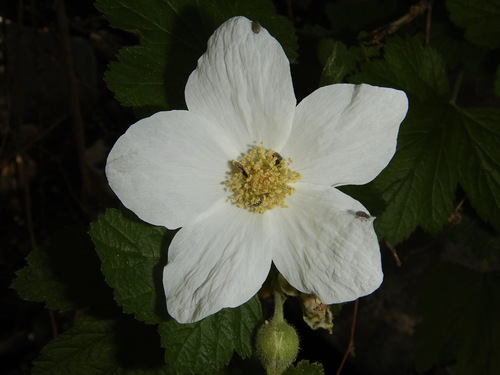
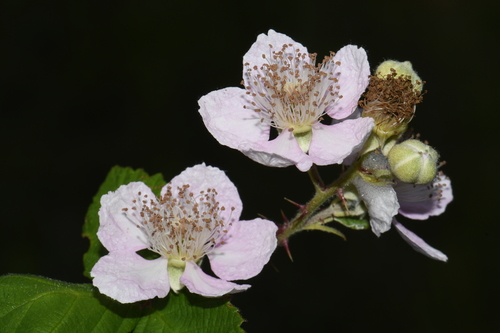
Rubus armeniacus is a perennial plant that grows biennial stems called canes from its permanent perennial root system. In its first growing year, a new stem grows vigorously to reach its full length of 4–10 meters, either trailing along the ground or arching to a height of up to 4 meters. The stem is stout, with a base diameter of 2–3 centimeters, and is green in color. It has a polygonal cross-section, most commonly hexagonal, with large formidable thorns up to 1.5 centimeters long that grow along the angular ribs of the stem. Canes that are exposed to bright sunlight often turn more red or purple, which happens frequently during the summer. Leaves on first-year shoots are 7–20 centimeters long, palmately compound, with either three or more commonly five leaflets. The leaflets have moderate serration along their edges, and first-year stems do not produce any flowers. In its second year, the stem does not grow any longer, but instead produces several side shoots that bear smaller leaves. These second-year leaves almost always have three leaflets, and rarely have just a single leaflet. The second-year leaflets are oval with a pointed tip, dark green on their upper surface, and pale to whitish on their lower surface. They have toothed margins, and small hooked thorns that catch on objects along the midrib on their underside. Flowers grow in late spring and early summer in panicles containing 3 to 20 flowers each, located at the tips of second-year side shoots. Each flower is 2–2.5 centimeters in diameter, with five white or pale pink petals. The flowers are bisexual, meaning they contain both male and female reproductive structures. In botanical terms, the fruit of this plant is not a true berry, but an aggregate fruit made of many small drupelets. It is 1.2–2 centimeters in diameter, and ripens to a black or dark purple color. Both first- and second-year shoots have sharp spines that are short, stout, and curved. Mature plants grow into a thick tangle of dense arching stems, and branches root from their node tips when these tips touch the ground. The fleshy growing tips of canes contain higher concentrations of the antifeedant compounds 2-heptanol and methyl salicylate than mature leaves do. At the concentration found in growing cane tips, 2-heptanol acts as an antifeedant against banana slugs (Ariolimax columbianus). The lack of phytophagous insects typically observed on growing cane tips is likely due to the presence of methyl salicylate. Methyl salicylate is a known aphid repellent, and has been shown to attract predators when plants produce it in response to insect herbivory.