About Rubroboletus pulcherrimus (Thiers & Halling) D.Arora, N.Siegel & J.L.Frank
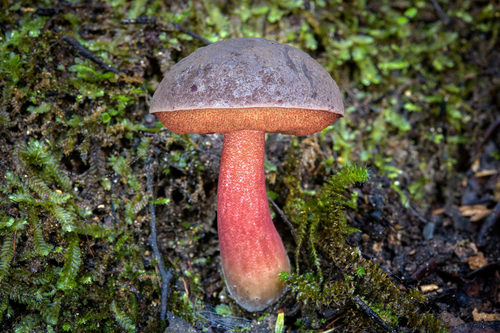
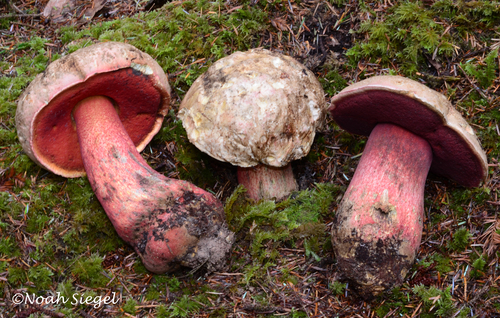
The cap of Rubroboletus pulcherrimus comes in various shades from olive-brown to reddish-brown, and may reach up to 25 centimeters (10 inches) in diameter. It is convex when young, and flattens out when it reaches maturity. Young cap surfaces are either smooth or velvety, while older specimens often develop a scaled texture; the cap margin curves inward in young fungi, and rolls outward to flatten as the fungus matures. Mature caps have a thickness of 3 to 4 cm (1.2 to 1.6 in).
The poroid hymenophore is adnate, meaning it attaches squarely to the stem, and ranges in color from bright red to dark red or red-brown. Bruising this surface causes it to turn dark blue or black. Young specimens have 2 to 3 pores per millimeter, and pores expand to around 1 to 2 per millimeter at maturity. In cross-section, both the tubes and flesh are yellow. Tubes are 0.5 to 1.5 cm (0.2 to 0.6 in) long; the angular pores are up to 1 mm in diameter, and change color from dark red when young to reddish brown when the fungus ages. Cutting or bruising the pores will turn them blue.
The stem is solid and firm, measuring 7–20 cm (3–8 in) long. It is thick, reaching up to 10 cm (4 in) in diameter at the base, and tapers to 2–5 cm (1–2 in) in diameter at the top. The stem is yellow or yellow-brown, and has a network of red reticulations covering the upper two-thirds of its length. The spore print of this species is olive-brown. The flesh has a reported mild taste, and the odor is either indistinct or slightly fragrant.
Rubroboletus pulcherrimus is distributed in western North America, ranging from New Mexico and California north to Washington, and may potentially occur in British Columbia, Canada. Different sources report conflicting elevation preferences: one notes it grows at low altitudes in the Cascade Range and Olympic Mountains, while another states it grows at high elevations over 5,000 ft (1,500 m). It fruits in autumn, growing either singly or in groups in humus within mixed woodlands, though one additional source claims it never grows in groups. In the original species description, Thiers and Halling noted that R. pulcherrimus associates with forests containing tanbark oak (Lithocarpus densiflora), Douglas-fir (Pseudotsuga menziesii), and grand fir (Abies grandis). Smith and Weber noted that fruiting increases after warm, heavy fall rains that follow a humid summer.
As a general rule, blue-staining red-pored boletes should not be eaten. Thiers warned this species may be toxic, after being informed that a person developed severe gastrointestinal symptoms just from tasting it. In 1994, a couple developed gastrointestinal symptoms after eating this fungus, and the husband died as a result. Autopsy found the man had suffered a midgut infarction. Rubroboletus pulcherrimus is the only bolete that has been implicated in a death following consumption. It is known to contain low levels of muscarine, a peripheral nervous system toxin. A 2005 report from Australia recorded a fatality from muscarinic syndrome after consumption of a mushroom from genus Rubinoboletus, though the species involved may actually belong to Chalciporus.