About Rousettus aegyptiacus (E.Geoffroy, 1810)
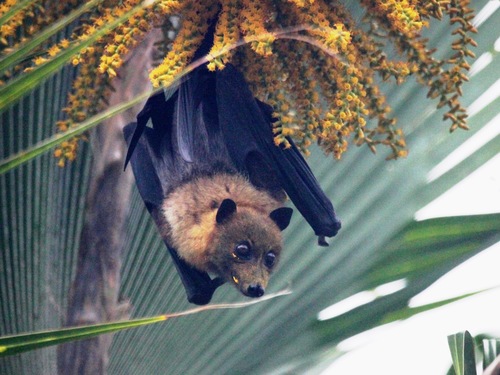
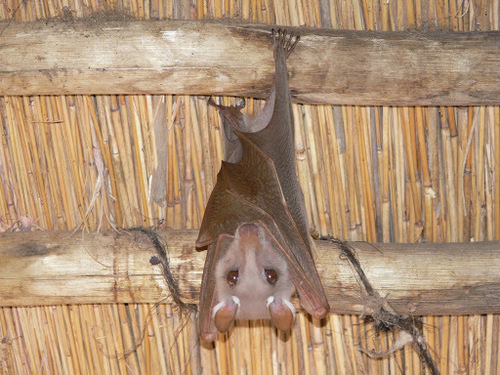
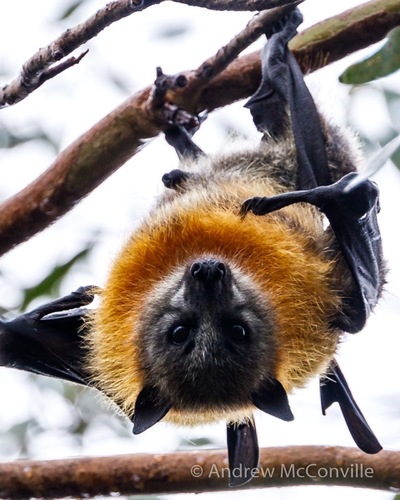
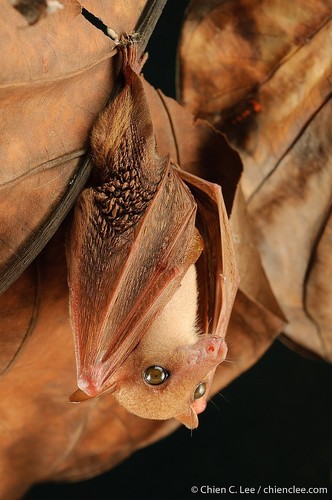
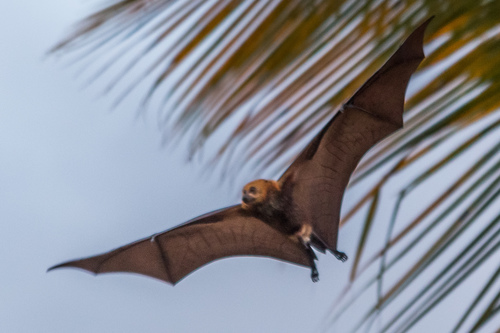
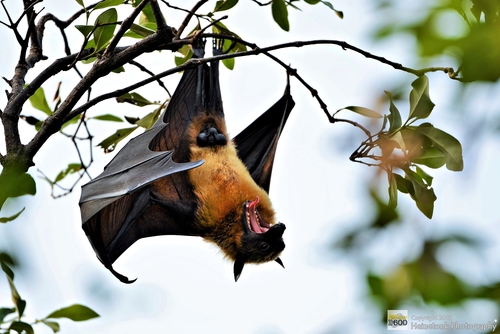
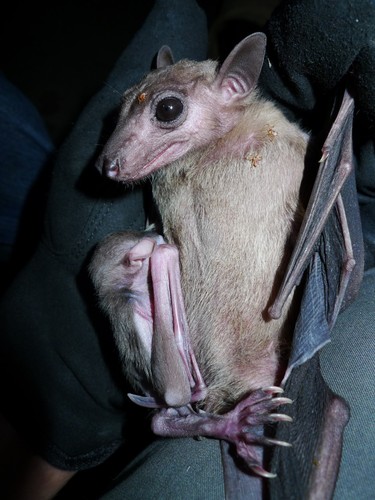
Rousettus aegyptiacus, commonly called the Egyptian fruit bat, is a medium-sized megabat. Adult individuals have an average total body length of 15 cm (5.9 in), an average wingspan of approximately 60 cm (24 in), a forearm length ranging from 81–102 mm (3.2–4.0 in), and a thumb length ranging from 22–31 mm (0.87–1.22 in). Adult body mass falls between 80–170 g (2.8–6.0 oz). Males are larger than females, and can be easily told apart by their large scrotums and prominent, stiff strands of hair around the throat. This species has a dental formula of 2.1.3.2 / 2.1.3.3, giving a total of 34 teeth. Its body fur is relatively short, made up of soft, sleek strands. Fur on the back ranges in color from dark brown to gray-brown, while the underside is pale brown, with a yellowish-brown collar around the neck. Its wings are a darker brown than its body, and the wing membranes attach to the leg at the first toe. Males and females have similar coloration. Like other megachiropteran species, the Egyptian fruit bat only has claws on its first and second digits; the other digits have cartilage at their extremities. The Egyptian fruit bat has one of the highest brain weight to body weight ratios of any bat species. It is well adapted for seeing in low light, and has a highly developed sense of smell. The regions of the brain associated with sight and smell are also well-developed. Its eyes are large and well-developed, while its ears are medium-length. As with all megabats, the choroid of the eye (the vascular region between the retina and sclera) has tiny projections called papillae, which are where the photoreceptor cells are located. The Egyptian fruit bat is widely distributed across Africa, the Middle East, Pakistan, and the northern regions of the Indian subcontinent. In the Mediterranean region, it is found on the mainland coast of Turkey and the island of Cyprus. It is the only frugivorous bat species native to Europe. Outside of its natural range, one individual was observed on the Greek island of Kastellorizo during a 2017 zoological expedition. The Egyptian fruit bat most often inhabits tropical rainforests, savannas, and other forest types, and typically lives in large colonies of thousands of individuals within established roosts. It prefers to roost near areas with abundant fruiting trees, and most roosts are located in caves. When no caves are available nearby, it will roost in cave-like human-made structures, such as abandoned depots and hangars. The Egyptian fruit bat has two annual breeding seasons: the first runs from April to August, and the second runs from October to February. When a breeding season begins, colony members separate by sex: males gather into bachelor groups, while females form maternity colonies. Female Egyptian fruit bats control copulation, so males increase their mating chances by offering nuptial gifts of fruit that females are allowed to eat. This gift-giving strengthens the pair bond, increasing the likelihood that a female will mate with a given male. Females usually give birth to only one offspring (called a pup) each year, though twins are occasionally born, after a gestation period of 115 to 120 days. Newborn pups are altricial at birth, and their eyes remain closed until they are nine days old. The female carries her pup until it is six weeks old, at which point the pup can hang on the roost on its own. After this, the pup is left in the roost while the mother forages. Before leaving the pup in the roost, the mother repeatedly moves the pup to the same tree, where it is left overnight while she forages. The pup learns this location, and when it is around three months old, it will leave the roost on its own to forage there first. Pups do not become independent of their mothers until nine months old, once they have reached full adult size. Offspring typically remain in the same colony as their parents for their entire lives. In the wild, the average lifespan of the Egyptian fruit bat is 8 to 10 years, while properly cared for captive individuals live around 22 years. The large difference in lifespan between wild and captive Egyptian fruit bats is mainly due to higher exposure to predation and higher rates of vitamin D deficiency in wild individuals.