About Rostroraja alba (Lacepède, 1803)
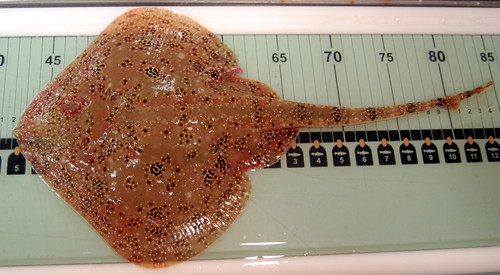
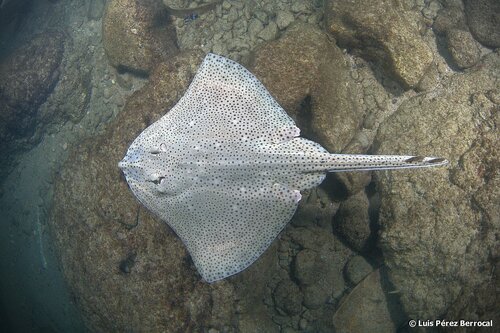
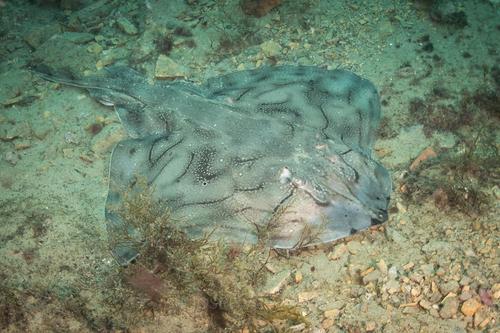
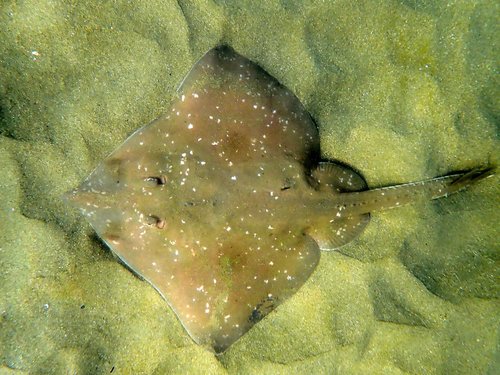
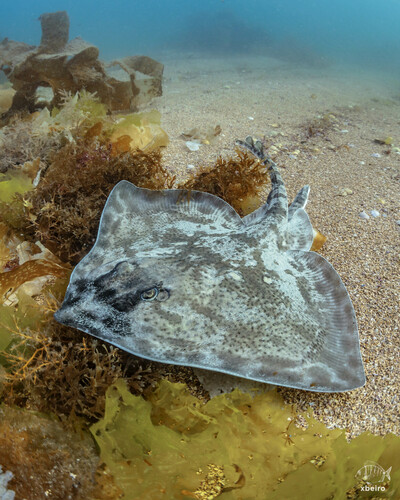
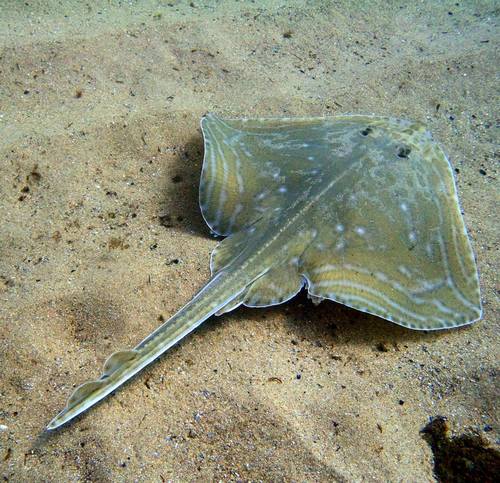
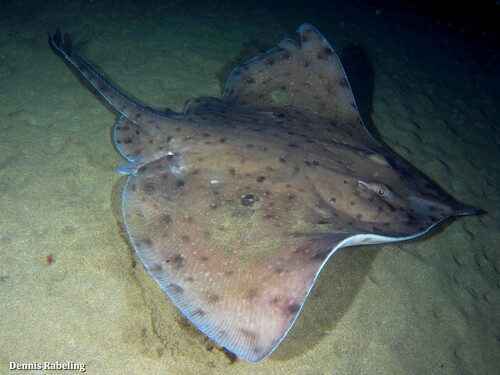
Most bottlenose skates (Rostroraja alba) measure 60–150 cm (24–59 in) in length. The maximum recorded length is 230 cm (91 in) for males and 202 cm (80 in) for females. Their flattened, angular pectoral fin disc is roughly 1.4–1.5 times as broad as it is long. The snout has a broad base, tapers abruptly to a protruding sharp point, and is covered with small, sharp thorns. There are 40–45 rows of teeth in the upper jaw. Juvenile bottlenose skates have 1 thorn before the eyes and 0–1 thorns behind the eyes, plus three rows of large thorns on the tail: 10–16 thorns along the midline, and 7–17 thorns on either side. Adult individuals have around 6 thorns around the inner margin of the eye socket, plus 16–30 mid-dorsal thorns and 17–29 lateral thorns on the tail. Adult skin is rough overall, except for a smooth patch at the center of the disc; the underside is prickly, apart from smooth patches on the snout. Young skates are entirely smooth except for the snout. Large juveniles and adults are greyish or bluish on the upper surface, with or without numerous small white spots; the underside is white, with brown to black disc margins. Hatchlings are plain reddish-brown on the upper surface, often with blue spots, and white on the underside, with broad dusky disc margins. The bottlenose skate is found along coastlines of the eastern Atlantic Ocean, ranging from southwest Ireland to South Africa, and extends into the southwestern Indian Ocean as far as Mozambique. It also occurs in the western and northeastern parts of the Mediterranean Sea. It is a benthic species that lives on sandy and detrital bottoms, at depths of 40–400 m (and exceptionally as deep as 500 m), from coastal regions to the upper continental slope. A 1974 report by Du Buit notes that this species is more common in rocky habitats. The bottlenose skate is a benthic predator that feeds on bony fishes, other elasmobranchs, fish offal, crabs, shrimps, mysids, octopus, and cuttlefish. Younger, smaller individuals are usually found in shallower water. Like other skates, this species is oviparous. After a 15-month gestation period, females produce 55–156 ova per year. The egg cases are oblong, with stiff pointed horns at each corner; the larger horns are flattened. Egg cases are deposited in sandy or muddy flats during the spring. The capsules measure 12.5–18.3 cm (4.9–7.2 in) long and 10–13.9 cm (3.9–5.5 in) wide. This species is estimated to reach sexual maturity at 130 cm (51 in) for males and 120 cm (47 in) for females.