About Rossia pacifica S.S.Berry, 1911
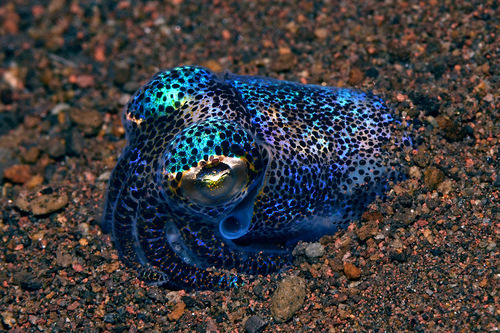
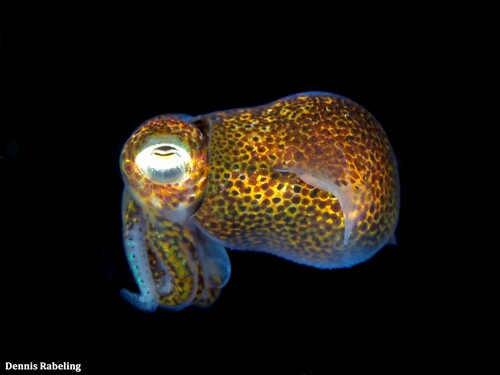
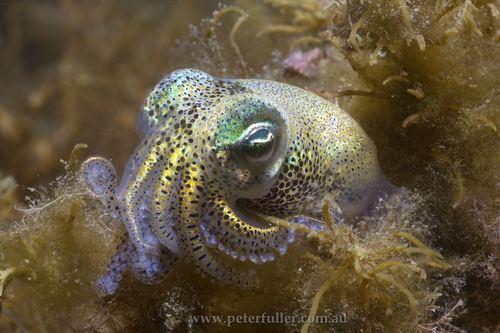
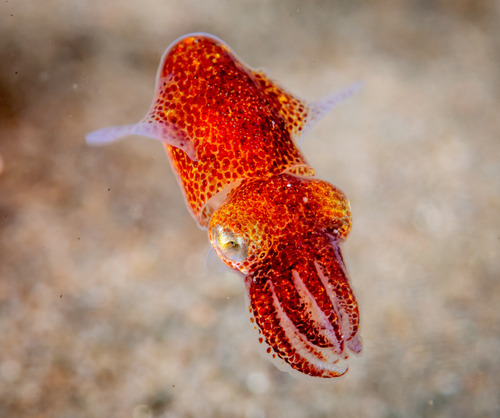
Rossia pacifica S.S.Berry, 1911, commonly called the stubby squid, is a small species. It reaches a maximum mantle length of about 5 cm (2.0 in) and a total length of 11 cm (4.3 in), and females grow larger than males. The head has eight short arms, a pair of retractable tentacles, and two large eyes. The first pair of arms is shorter than the other arms, and the third pair is the longest. The arms are circular in cross-section; each arm has up to four rows of suckers on its middle section, and two rows of suckers on other sections. The tentacles have club-shaped tips covered in suckers, and retract into pits in the head. When fully extended, the tentacles can be as long as the squid's entire body. The mantle, which is the squid's body, is not fused to the head. It is flattened dorso-ventrally, rounded at the posterior end, and does not contain the cuttlebone that is typical of cuttlefish in the family Sepiidae. Two large semi-circular fins with wide bases are located on either side of the mantle. The upper surface of this bobtail squid is normally reddish-brown with a scattering of small brown or yellowish spots, but can change to greyish-green when the animal is startled. The stubby squid is native to the northern Pacific Ocean. Its range extends from Korea, Japan and the Bering Sea to the western coast of North America, reaching as far south as California. It occurs at depths between 20 and 1,300 m (66 to 4,265 ft). Researchers from the Monterey Bay Aquarium Research Institute (MBARI) were the first to report a sighting of a stubby squid at 1,300 m (4,300 ft), which is deeper than the previous confirmed observation at 900 m (3,000 ft). In Puget Sound, this squid is seen in winter in areas of sloping muddy sand, far from strong currents, at depths less than 300 m (984 ft), but moves into deeper water during the summer. In coastal regions, it is typically found in the subtidal zone between 16 and 370 m, and has been observed swimming near shore in the intertidal zone at night. Breeding occurs in late summer and autumn, in deep water. The male uses his hectocotylus, which is his modified first left arm, to transfer spermatophores (sperm bundles) into the female's mantle cavity. Both mature males and females die approximately two years after hatching, soon after breeding. An average female deposits between twenty-five and fifty eggs in clusters, attaching the clusters to the underside of stones, clams, or sponges. The egg capsules are hard, durable, and creamy-white. The eggs take four to nine months to hatch, and receive no parental care after being laid. The individual egg, which is 4–5 mm in diameter, is contained inside a larger capsule measuring 8 mm by 15 mm. Newly hatched juvenile squid are fully formed miniature versions of adult stubby squid.