About Roscoea purpurea Sm.
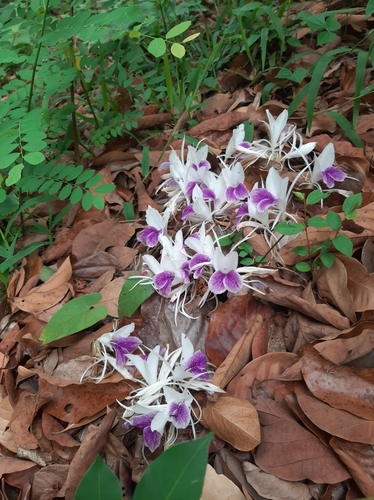
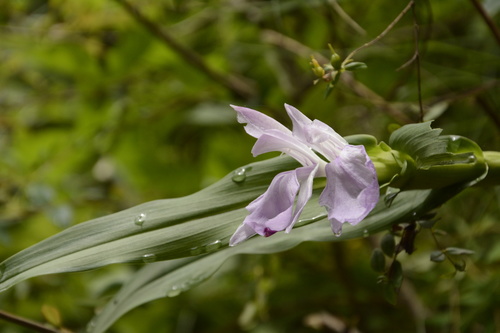
Roscoea purpurea Sm. is a perennial herbaceous plant. Like all species in the genus Roscoea, it dies back each year to a short vertical rhizome, to which tuberous roots are attached. When new growth starts, it produces pseudostems – structures that look like stems but are actually made from the tightly wrapped leaf bases (called sheaths). R. purpurea can grow to over 50 cm tall, with a stout pseudostem and wide leaves, though its height varies. Its leaf sheaths are pale green, and may sometimes have a dark reddish-purple tinge. The peduncle (stem of the flower spike) is hidden by the leaf sheaths. Its flowers are larger than those of any other species in the genus Roscoea. They are most commonly purple to mauve, though white- and red-flowered forms have been discovered in Nepal. Each flower follows the typical structure for the genus Roscoea. It has a tube-shaped outer calyx. Inside the calyx, the three petals (the corolla) form a tube slightly longer than the calyx, ending in three lobes: an upright hooded central lobe, and two slightly smaller side lobes. Inside the petals are structures formed from four sterile stamens called staminodes: two lateral staminodes look like small upright petals, and two central staminodes are partially fused at the base to form a lip or labellum.
Roscoea purpurea is native to the Himalayas, and especially Nepal. It grows in a variety of both damp and dry habitats. It has been recorded growing in alpine grassland, on rock faces and terraced walls, in clearings, and at woodland edges. It grows in both full sun exposure, and shaded locations under other herbaceous plants, shrubs, or trees.
Roscoea purpurea is pollinated by the long tongue fly Philoliche longirostris, which is an obligate pollinator for this species. Philoliche longirostris is the only long-tongued fly species found in the Himalayas, and has the longest proboscis of any member of the Tabanidae family. The fly's seasonal activity is very closely synchronized with the peak blooming period of R. purpurea. Pollen transfer happens when the fly pushes against staminal appendages that extend from the stamen base at the opening of the corolla tube. This movement pushes the anther, style, and stigma downward, so they touch the fly's back to transfer pollen.
Cultivation notes mention that for many years, the species Roscoea auriculata was grown in gardens under the name R. purpurea, as noted by Jill Cowley. Cowley lists multiple distinguishing features between the two: R. auriculata has auriculate leaves, brighter purple flowers than the paler blooms typical of R. purpurea, shorter white lateral staminodes, and a deflexed (bent back) labellum. Like other Roscoea species and cultivars, R. purpurea is often grown in rock gardens. It generally grows best in a relatively sunny position with moisture-retaining but well-drained soil. Since it does not emerge above ground until late spring or even early summer, it avoids frost damage in regions that experience subzero temperatures. When grown at the Royal Botanic Gardens, Kew, R. purpurea only emerges from the ground in June, and flowers from late July to early September, and requires partial shade during the day.
R. purpurea was included in a trial of Roscoea run by the Royal Horticultural Society (RHS) from 2009 to 2011. It proved to be hardy, with an H4 rating, meaning it is hardy anywhere in the British Isles. One form and three cultivars have received the RHS Award of Garden Merit (AGM): R. purpurea f. rubra (formerly called 'Red Gurkha'), which produces red-orange flowers; R. purpurea 'Dalai Lama', whose flowers have pale violet labellums with deeper violet throats marked white, and deep red leaf sheaths; R. purpurea 'Helen Lamb', which is strong growing, and produces many flowers similar in colour to the typical form of the species; and R. purpurea 'Red Neck', which has pale flowers with strongly red-marked floral bracts and sheaths. A red-flowered form discovered in Nepal was first named R. purpurea 'Red Gurkha', but cultivated plants vary, especially in leaf sheath colour (which can be plain green or red-marked), so the RHS determined a form name was more appropriate, and the AGM was awarded to R. purpurea f. rubra. Red flower colour is not found naturally anywhere else in the genus. For propagation information, see the entry for Roscoea, section on Cultivation.