About Rosa setigera Michx.
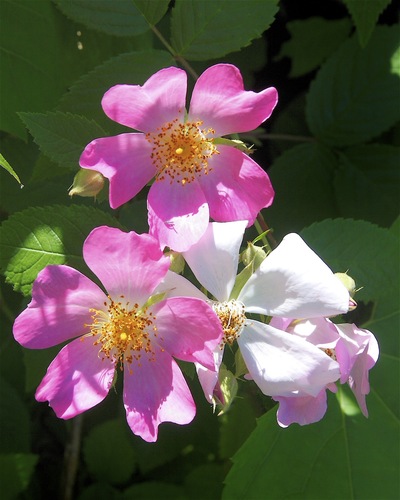
Rosa setigera Michx. (R. setigera) has trailing or climbing slender stems that reach up to 5 metres (15 ft) in length. It grows either as a vine or forms a sprawling thicket. In open areas, its stems arch downward once they reach a height of roughly 1 metre (3 ft), and root wherever they touch the ground. In areas with existing vegetation or other structures, its stems typically climb. Its stems are green or brown with a reddish tint, and bear curved prickles. Its leaves are alternate and compound, with 3 to 5 leaflets per leaf. Each full leaf measures 8–12 centimetres (3.1–4.7 in) long, while the individual leaflets are 3–5 centimetres (1.2–2.0 in) long and 1.5–4 centimetres (0.6–1.6 in) wide. Leaflets are ovate, with serrate or doubly serrate edges. Its fragrant flowers bloom from May to July; they are most often pink, occasionally white, and grow either singly, in small groups, or in panicles on stalks. Each flower is around 8 centimetres (3 in) wide, with large petals and numerous stamens. Bright red rose hips, the fruit of the plant, develop later in the summer. The range of R. setigera overlaps with that of several other Rosa species, including some invasive types. It can be distinguished from invasive Rosa multiflora by its common pink flowers, as R. multiflora only produces white flowers; the rose hips of the two species are fairly similar. Dog rose (Rosa canina) may also have small pink flowers, but its rose hips are larger and more cylindrical than those of R. setigera. R. setigera can also be told apart from the related native Rosa carolina: R. carolina generally grows lower to the ground, and produces larger flowers and larger rose hips. R. setigera is native to North America. In the United States, its native range extends from Texas and Nebraska in the west, north to Wisconsin, east to New Hampshire, and south to Florida. It is also native to Ontario, Canada, where it is listed as a species of special concern due to habitat loss. It grows in areas with average to moist, well-drained soils, and can be found in forests and woodlands, roadsides, bluffs, streambanks, old fields, and pastures. Flowers bloom from spring to summer, with rose hips developing later in the same summer. Bees pollinate the flowers, and a variety of other insects feed on the plant. Birds and mammals consume the rose hips. R. setigera acts as a larval host plant for several moth species, including Paleacrita vernata (spring cankerworm), Stigmella rosaefoliella, and Coptotriche roseticola.