About Rosa L.
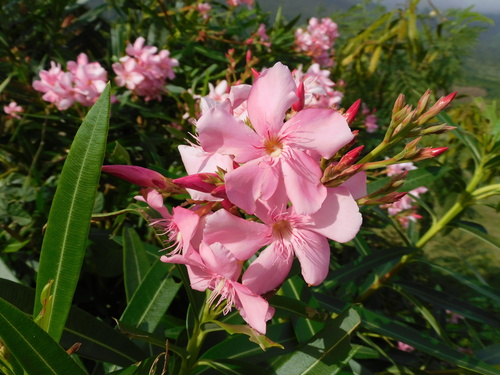
Nerium oleander (oleander) grows to 2–6 metres (7–20 feet) tall, with erect stems that splay outward as they mature. First-year stems have a glaucous bloom, while mature stems develop grayish bark. Its leaves grow in pairs or whorls of three, are thick and leathery, dark green, and narrow lanceolate. They measure 5–21 centimetres (2–8 inches) long and 1–3.5 cm (3⁄8–1+3⁄8 in) broad, with an entire edge covered in the fine reticulate venation web typical of eudicots. Young leaves are light green and very glossy, maturing to a dull dark green. Flowers grow in clusters at the end of each branch; they range in colour from white to pink to red, have a 2.5–5 cm (1–2 in) diameter, and feature a deeply 5-lobed fringed corolla surrounding a central corolla tube. They are often, but not always, sweet-scented. The fruit is a long, narrow pair of follicles 5–23 cm (2–9 in) long, which splits open at maturity to release numerous downy seeds. Nerium oleander is either native or naturalized across a broad range extending from northwest Africa through the Mediterranean region, warmer areas of the Black Sea region, the Arabian Peninsula, and southern Asia, reaching as far east as Yunnan in southern China. It typically grows around stream beds in river valleys, and can tolerate both long drought seasons and inundation from winter rains. The species is planted in many subtropical and tropical areas worldwide. On the US East Coast, it grows as far north as Virginia Beach, while in California and Texas, miles of oleander shrubs are planted on highway median strips. An estimated 25 million oleanders are planted along highways and roadsides across California. Due to its durability, oleander was planted prolifically on Texas's Galveston Island after the devastating 1900 Hurricane. It has become so common there that Galveston is known as the 'Oleander City', and hosts an annual oleander festival every spring. Moody Gardens in Galveston runs the propagation program for the International Oleander Society, which promotes oleander cultivation. New varieties are hybridized and grown on the Moody Gardens grounds, covering every existing named variety. Outside its traditional Mediterranean and subtropical range, oleander can also be cultivated in mild oceanic climates with proper precautions. It is grown without protection in warmer parts of Switzerland, southern and western Germany, and southern England. It can reach large sizes in London, and to a lesser extent in Paris, due to the urban heat island effect. This is also true for Pacific Northwest North American cities including Portland, Seattle, and Vancouver. Plants may suffer damage or die back in these marginal climates during severe winter cold, but will regrow from their roots. Some invertebrates are unaffected by oleander toxins and feed on the plant. Caterpillars of the polka-dot wasp moth (Syntomeida epilais) feed specifically on oleanders, surviving by eating only the pulp surrounding leaf veins and avoiding the leaf fibers. Larvae of the common crow butterfly (Euploea core) and oleander hawk-moth (Daphnis nerii) also feed on oleanders, and they retain or modify the plant's toxins, which makes them unpalatable to predators such as birds, but not to other invertebrates like spiders and wasps. Oleander flowers require insect visits to set seed, and appear to be pollinated via a deception mechanism. Their showy corolla acts as a strong advertisement to attract pollinators from a distance, but the flowers produce no nectar and offer no reward to visitors. As a result, they receive very few insect visits, which is typical for many rewardless flower species. This means fears of honey contamination from toxic oleander nectar are unsubstantiated. Oleander is a poisonous plant that contains toxic compounds, especially when consumed in large quantities. These compounds include oleandrin and oleandrigenin, which are cardiac glycosides with a narrow therapeutic index and are toxic when ingested. Ingestion causes side effects including weakness, diarrhoea, nausea, vomiting, headache, stomach pain, and can result in death. Toxicity studies in animals have found that birds and rodents are relatively insensitive to administered oleander cardiac glycosides. However, other mammals such as dogs and humans are relatively sensitive to the effects of cardiac glycosides and the clinical symptoms of glycoside intoxication. Oleander is also hazardous to grazing animals including sheep, horses, and cattle; as little as 100 g of the plant is enough to kill an adult horse. Fresh plant clippings are especially dangerous to horses because they are sweet, and in July 2009, several horses were poisoned this way by oleander leaves. Poisoned horses show symptoms including severe diarrhea and an abnormal heartbeat. This hazard is reflected in the plant's Sanskrit name aśvamāra (अश्वमार), a compound of aśva 'horse' and māra 'killing'. Reviewing hospital-treated oleander toxicity cases, Lanford and Boor concluded that, except for children who may face greater risk, human mortality from oleander ingestion is generally very low, even in cases of moderate intentional consumption (suicide attempts). A rare fatal oleander poisoning case occurred in 2000, when two toddlers adopted from an orphanage ate oleander leaves from a neighbour's shrub in El Segundo, California. Because oleander is extremely bitter, officials speculated the toddlers had pica, a malnutrition-related condition that causes people to eat otherwise inedible material. Ingestion of oleander affects the gastrointestinal system, heart, and central nervous system. The main effect of oleander's cardiotoxic glycosides is positive inotropy. The glycosides bind to the sarcolemma transmembrane ATPase of cardiac muscle cells, competing with K+ ions and inactivating the enzyme. This causes Na+ and Ca2+ ions to accumulate inside cardiac muscle cells, leading to stronger and faster heart contractions. Additionally, increased extracellular K+ ions may lead to lethal hyperkalemia. Clinical features of oleander poisoning are therefore similar to digoxin toxicity, and include nausea, diarrhea, and vomiting caused by stimulation of the area postrema of the medulla oblongata, as well as neuropsychic disorders and pathological motor manifestations. Cardiotoxic glycosides also stimulate the vagus nerve (causing sinus bradycardia) and the phrenic nerve (causing hyperventilation), and can lead to lethal brady- and tachyarrhythmias, including asystole and ventricular fibrillation. Oleander poisoning can also cause blurred vision and other vision disturbances, including halos appearing around objects. Oleander sap can cause skin irritations, severe eye inflammation and irritation, and allergic reactions presenting as dermatitis. The severity of intoxication varies based on the quantity ingested, an individual's physiological response, and how quickly symptoms develop after ingestion: symptoms can appear rapidly after drinking teas made with oleander leaves or roots, or develop more slowly after eating unprepared plant parts.