About Rosa arvensis Huds.
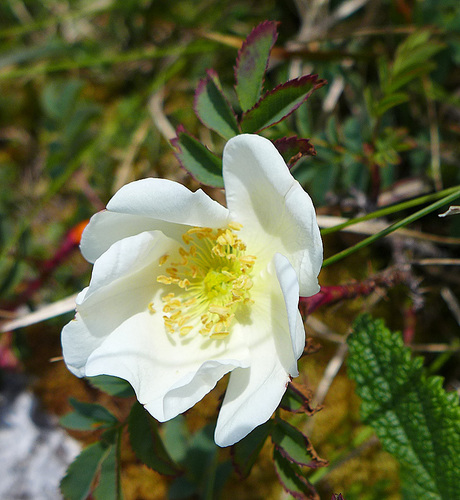
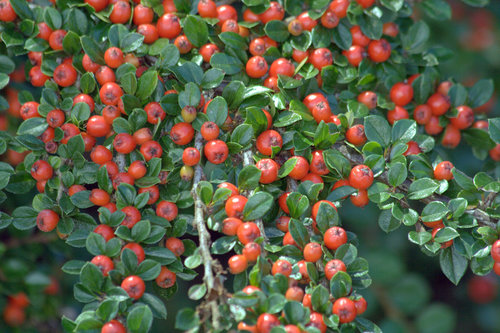
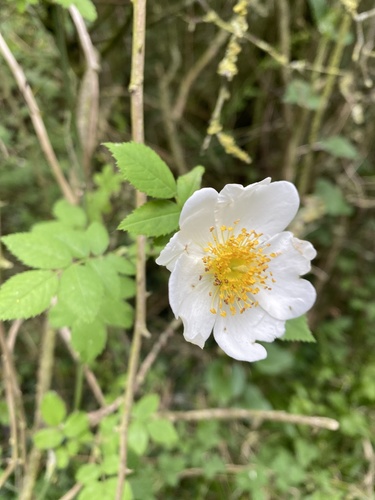
Rosa arvensis Huds. is a vigorous, thorny, rambling shrub. It grows between 3 and 3.7 metres (9.8 and 12.1 ft) tall, with long arching or scrambling purple stems. Its flowers are slightly fragrant, single, creamy-white to white, 4 to 5 centimetres (1.6 to 2.0 in) across, and are produced in one flush during midsummer. In England, this blooming period falls in July, while in Bulgaria it occurs from May to June. After flowering, it produces oval, orange-red to red fruits called hips.
Rosa arvensis was first identified in England, and has since been observed across much of Europe. In England, it grows principally in hedges and thickets; in Bulgaria, it also forms part of the understory of deciduous forests. Confirmed native populations are found across most of the British Isles, France, Belgium, the Pyrenees (at altitudes up to 1000 m), scattered localities elsewhere in Spain, western and southern Germany, the foothills of the Alps (up to 1330 m in the Central and Eastern Alps, up to 1400 m in the Maritime Alps), Italy, Western Hungary, the Little Carpathians of Slovakia, the Carpathians of Romania, and most of the Balkan Peninsula (up to 1000 m in Bulgaria). Isolated reports of this species from North-western Africa, southern Anatolia and the Levant are likely actually misidentifications of R. phoenicia. In Caucasia, Rosa arvensis only occurs as a cultivated plant.