About Romulea tortuosa (Licht. ex Roem. & Schult.) Baker
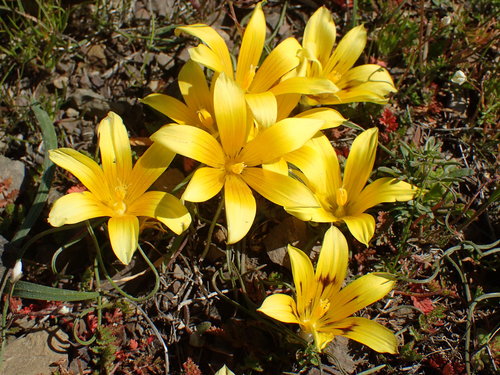
Romulea tortuosa is a very low-growing perennial plant reaching 3–6 cm (1.2–2.4 in) in height. It survives dry southern summers by storing resources in an oval corm covered in a brown, rigid tunic. This species produces three to four spreading, firm, awl-shaped basal leaves that are coiled like corkscrews; these leaves measure 3¾–5 cm (1½–2 in) long, about 1 mm (0.04 in) in diameter, and have three veins. Two or three flowers emerge from the base of the leaves, almost without any visible stem. Each flower is subtended by two green, lanceolate, non-coiling bracts that are 1¼ cm (½ in) long. The bright yellow perianth is made up of six tepals that are merged near their base, forming a short tube at the base and a 1¼ cm (½ in) tall cup, with egg-shaped lobes. The anthers are located in the upper half of the flower cup and are narrowly arrow-shaped. The nominate subspecies, R. tortuosa subsp. tortuosa, has brown blotches near the bottom of the flower cup, which are not present in R. tortuosa subsp. aurea. Open flowers of Romulea tortuosa have a scent similar to narcissus blossoms. In its ecology, Romulea tortuosa is mostly visited by common honey bees and other bee species including members of the sweat bee family, and is sometimes also visited by the monkey beetle Lepithrix forsteri.