About Romjularia lurida (Ach.) Timdal
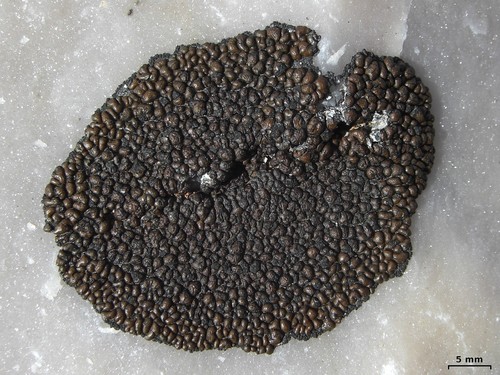
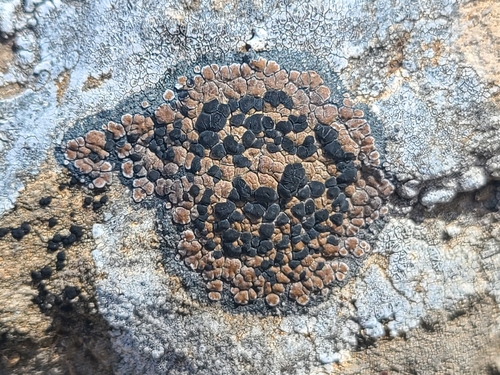
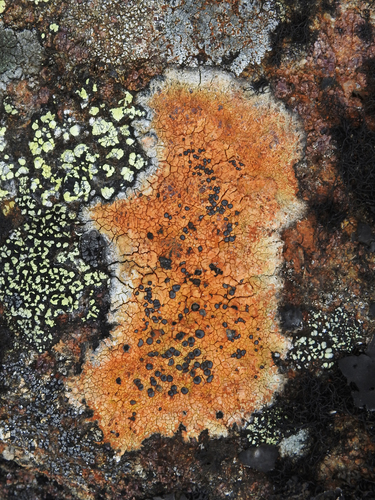
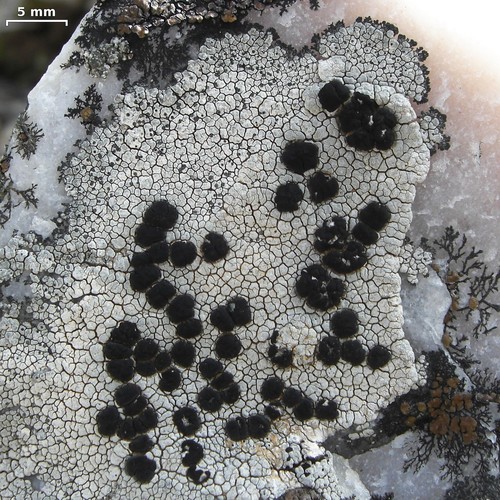
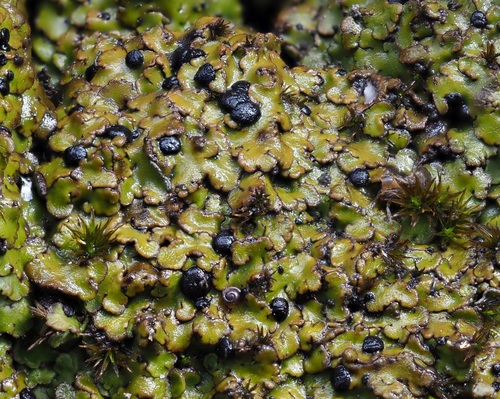
Romjularia lurida is a lichen defined by a squamulose thallus, which is made up of small, scale-like structures called squamules that can reach up to 5 mm in length. As these scales mature, they often grow upright, develop brown or pale brown upper surfaces, and have margins that curl under. The underside of the thallus is pale in color. The thallus attaches to its growing surface, or substrate, via rhizoidal strands, which are root-like structures. The cortex, the outer layer of the thallus, is formed from paraplectenchymatous tissue, a tissue type consisting of tightly packed fungal cells. The upper section of the cortex is brown, with a necrotic (dead tissue) layer located above it. The lichen’s fruiting bodies, called apothecia, are small, growing up to 1.5 mm in diameter. They can occur either along the edges of the thallus (marginal placement) or across the thallus surface (laminal placement). These apothecia are convex and red-brown, with an outer apothecial layer called an exciple that is also red-brown, and fades to a lighter shade toward its interior. Internal apothecial layers include a brown hypothecium, and a hymenium that measures 80–100 μm thick. After being treated with potassium hydroxide solution, the hymenium first reacts to iodine by turning reddish-yellow, then blue. The apothecia hold spore-producing cells called asci, which are clavate (club-shaped). The spores of Romjularia lurida are hyaline, smooth, and ellipsoid, with dimensions of 11–14 by 6–7 μm. This lichen also produces small, sessile pycnidia, which are structures that support asexual reproduction. Romjularia lurida does not contain any unique lichen substances. The exciple and epihymenium (the outermost layer of the hymenium) react to hydrochloric acid by turning red, but show no reaction to potassium hydroxide, a result noted as K-. Romjularia lurida is primarily documented to grow in temperate regions of Europe, including across most of Britain and Ireland. It has also been recorded in North Africa, Western Asia, and a small number of scattered locations in North America. It grows on siliceous rocks and on calcareous soils, in open, sun-exposed habitats.