About Roemeria argemone (L.) C.Morales, R.Mend. & Romero García
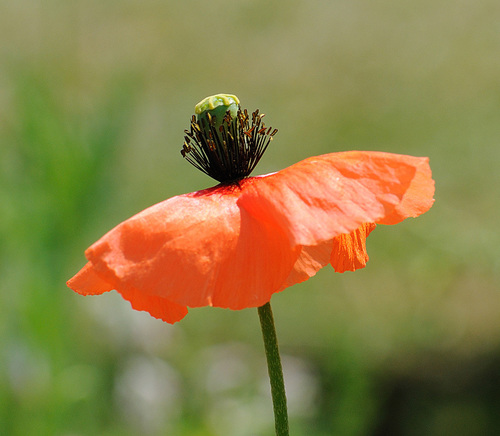
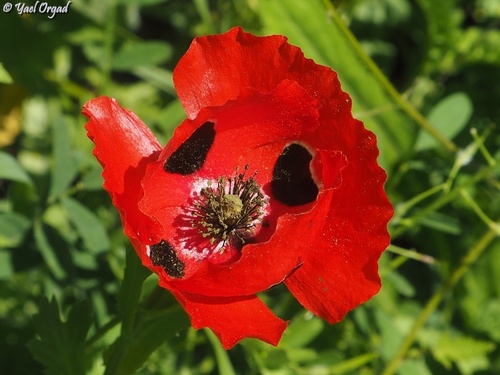
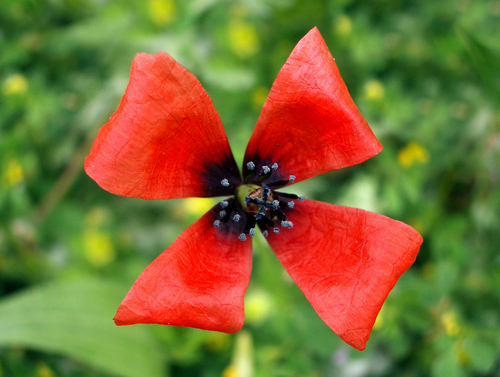
This annual plant species, Roemeria argemone, grows up to 50 cm (20 in) tall. Its 15–50 cm (6–20 in) long, branching stems are covered in stiff prickly hairs. The plant has fern-like green leaves: basal leaves have stalks, while upper leaves are stalk-less. All leaves can reach up to 20 cm (8 in) in length. It blooms from spring to summer, between May and July. Its flowers have four slightly overlapping red petals, each with a dark base. Open flowers measure 2–5.5 cm (0.8–2.2 in) across, and feature pale blue anthers and 4 to 6 stigmas. After flowering, the plant produces an oblong to club-shaped (clavate) ribbed seed capsule that grows up to 2 cm long. Roemeria argemone is native to temperate regions of North Africa, Europe, and Western Asia, including Macaronesia, the Canary Islands, Algeria, Egypt, and Morocco in North Africa. In Western Asia, it occurs in the Caucasus, Armenia, Cyprus, the Sinai region of Egypt, Iran, Iraq, Israel, Jordan, Lebanon, Syria, and Turkey. In Europe, it is found in eastern Europe (Belarus, Estonia, Latvia, Lithuania, Moldova, Ukraine), middle Europe (Austria, Belgium, Germany, Hungary, Netherlands, Poland, Slovakia, Switzerland), northern Europe (Denmark, Ireland, Sweden, United Kingdom), southeastern Europe (Albania, Bosnia and Herzegovina, Croatia, Greece, Italy, Montenegro, North Macedonia, Romania, Serbia, Slovenia), and southwestern Europe (France, Portugal, Spain). It has been introduced to the U.S. states of Idaho, Oregon, Pennsylvania, and Utah. It grows in fields and disturbed soils, including ploughed soils, and is typically found at elevations between 0 and 300 m (0 to 1,000 ft) above sea level. Historically, this pale poppy has been used in herbal medicine.