About Rocio octofasciata (Regan, 1903)
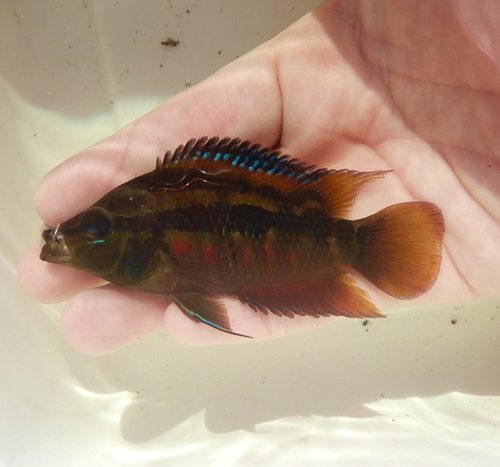
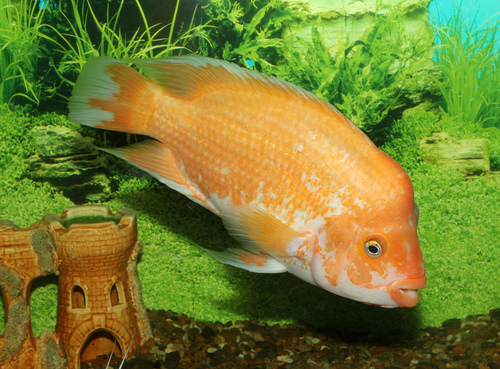
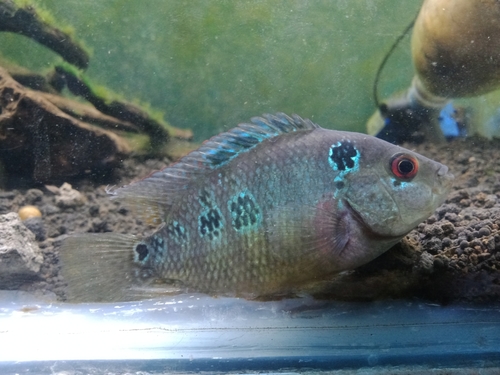
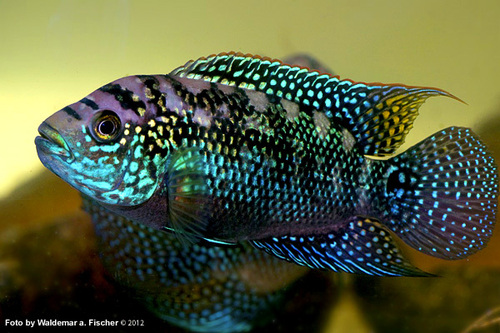
Rocio octofasciata (Regan, 1903), commonly called the Jack Dempsey cichlid, is a medium-sized cichlid fish. This species can be distinguished from other cichlids by two grey-black bars on the top of its head that extend forward between its eyes. Its wild background color is dark blue, with a series of white to iridescent blue spots covering its fins, head, and body, plus a series of dark bars along its sides. Coloration changes as the fish matures: young fish are light gray or tan with faint turquoise flecks, while mature fish become dark purple-gray with very bright, iridescent blue, green, and gold flecks. An individual’s colors will also change when it is under stress. Mature males have long, pointed tips on their dorsal and anal fins, which females do not have. During breeding, both sexes darken considerably, appearing almost black with little to no metallic coloration. Several captive color variants are sold in the aquarium trade, including Gold, Electric Blue, and pink (a variant that displays both gold and blue traits). Males can reach a maximum length of 25 cm (10 inches).
This fish is native to slow-moving freshwater habitats ranging from southern Mexico to Honduras. It is most often found in warm, murky waters including swampy areas, weedy mud- or sand-bottomed canals, drainage ditches, rivers, mangroves, and the lower reaches of rivers and streams. It has been introduced and established as an invasive species in Australia, the United States, and Thailand, likely after escaping from aquariums; in these introduced areas it is sometimes locally known as the Mexican Blue Frontosa.
In its native range, the Jack Dempsey cichlid lives in a tropical climate. It prefers water with a pH of 6–7, a water hardness of 9–20 dGH, and a temperature between 22–30 °C (72–86 °F). It is a carnivorous species, feeding on worms, crustaceans, insects, and other fish.
For reproduction, Jack Dempseys lay their eggs on a flat, hard surface within their territory, such as rocks, logs, or the glass bottom of an aquarium. Like most cichlids, they provide substantial parental care: both parents help incubate the eggs and guard the fry after hatching. They are attentive parents that will pre-chew food to feed to their offspring. However, it is not uncommon for breeding pairs to eat their fry if they are overly disturbed or if there is a problem with their environment. Females lay approximately 500–800 eggs per clutch. Both parents protect the eggs, and become extremely aggressive toward other fish during the spawning season.