About Rochia nilotica (Linnaeus, 1767)
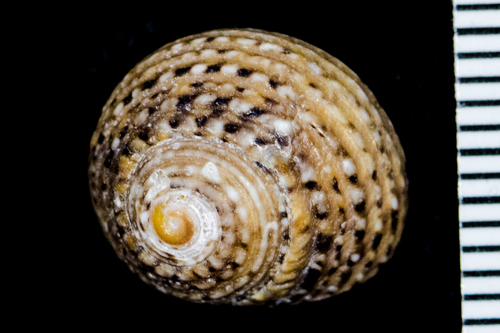
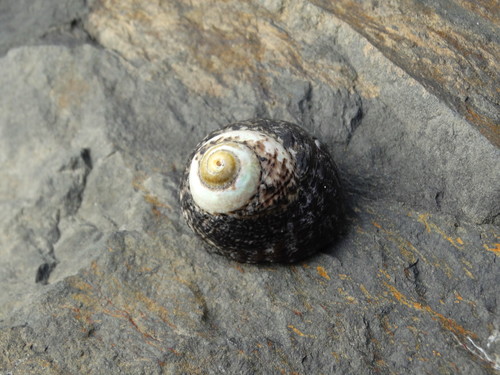
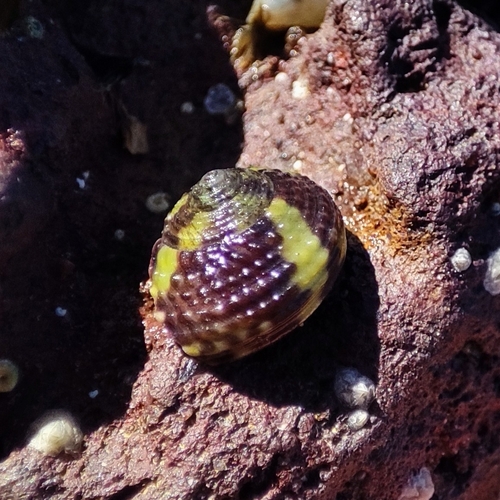
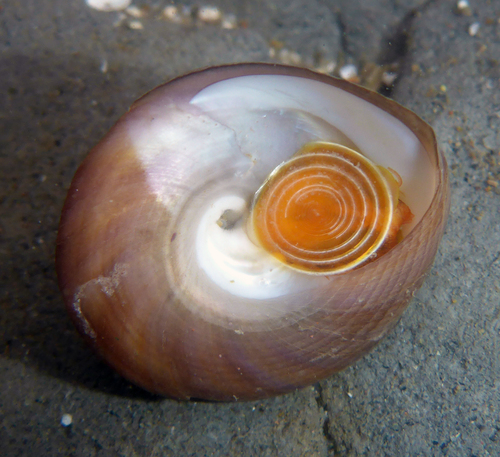
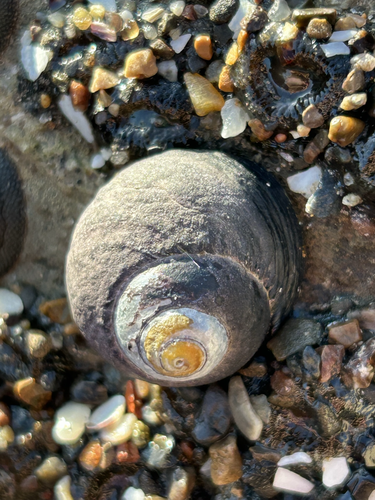
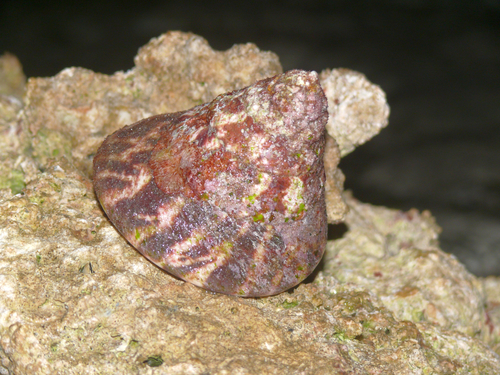
The shell of Rochia nilotica varies between 50 mm and 165 mm in length, and between 100 mm and 120 mm in diameter. This large, heavy shell has a conical shape and is considered subperforate. It is covered by a corneous, striate brown or yellowish cuticle that is usually lost on the upper whorls. Beneath the cuticle, the shell is white and marked with longitudinal stripes in crimson, violet, or reddish brown. The shell base is spotted or radiately striped with a lighter shade of the same color. The spire is distinctly conical, with an acute apex that is usually eroded. The shell holds between 8 and 10 whorls. The upper whorls are tuberculate at the sutures and spirally beaded, while the following whorls are flat on their outer surfaces, smooth, and separated by a linear suture. The body whorl is expanded, dilated, and compressed at the obtuse periphery, more or less convex below, and indented at the axis. The umbilical tract is covered by a spiral pearly callus that extends deeply inward. The aperture is transverse and very oblique. The columella is oblique, ending in a denticle at its lower end, and has a strong spiral fold at its upper end that extends deep into the axis. The operculum is circular, thin, corneous, and orange-brown, and is made up of approximately 10 whorls.
This is a widespread marine species found across the Indo-Pacific. Its range extends from Madagascar, Sri Lanka, and the Andaman and Nicobar Islands east to French Polynesia, north to southern Japan and Hawaii, and south to Australia, including locations such as New Ireland, New Caledonia, northern Australia, and French Polynesia.
Juvenile Rochia nilotica live in shallow intertidal reef flat areas, while adults prefer atoll reefs along the reef crest or on reef slopes at depths from 0 to 20 meters. These gastropods graze on very small plants and filamentous algae that grow on coral and rocks.
Rochia nilotica can live up to 15 years, and reaches reproductive maturity at around 2 years of age. Females release more than 1 million eggs. Breeding takes place during spring tides, with spawning occurring at night. Males fertilize the eggs, which then hatch into larval stages. Embryos develop into free-swimming planktonic marine trochophore larvae, and later become juvenile veligers that drift with currents before settling on rocky surfaces. Individuals become adults after 2 or more years.