About Robinia neomexicana A.Gray
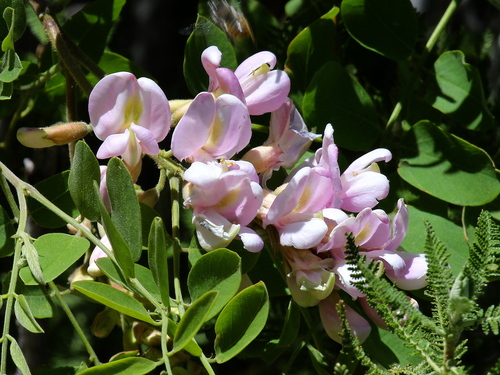
Robinia neomexicana A.Gray typically reaches 5 to 10 meters in height, and rarely grows as tall as 15 meters. Its shoots are covered in bristles. Its leaves are 10 to 15 centimeters long, pinnate, and bear 7 to 15 leaflets; a pair of sharp reddish-brown thorns grows at the base of each leaf. This species produces showy, fragrant flowers that are either white or pink. Flowers bloom in spring or early summer, borne in dense hanging racemes 5 to 10 centimeters long that grow near the ends of branches. Its fruits are brown, bean-like pods covered in bristles that match those found on the plant's shoots. Robinia neomexicana is native to the Southwestern United States and adjacent northern Mexico. Its United States range extends from southeastern California and southwestern Utah's Virgin River region, east through Arizona and New Mexico's Rio Grande valley, to far western Texas. From central New Mexico, its range extends north into Colorado, occurring mostly on the eastern foothills of the Rocky Mountains. In Arizona, it grows across the Arizona transition zone, the Mogollon Rim, the White Mountains, and extends into western and southwestern New Mexico. In California, it is uncommon below 1,500 meters (4,900 ft) where it grows in canyons of the Mojave Desert and in the region's sky island pinyon-juniper habitats composed of Pinus monophylla and Juniperus californica. Further east within its range, it is typically found between 1,200 and 2,600 meters (3,900 and 8,500 feet) along streams, at the bottom of valleys, and on the sides of canyons. Pueblo Native Americans in New Mexico traditionally ate the uncooked flowers of this species. Some Native American groups, including the Mescalero and Chiricahua Apache, ate the raw and cooked pods. Mule deer, cattle, and goats browse the foliage of this plant. Cattle also consume its flowers, while squirrels and quail eat its seeds.