About Rivina humilis L.
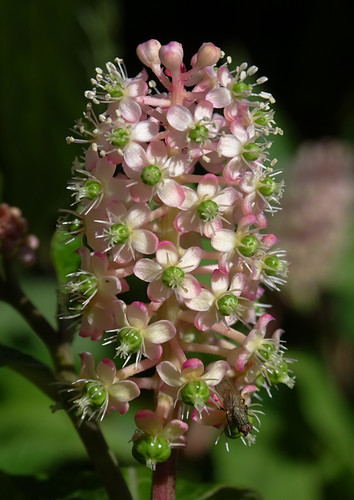
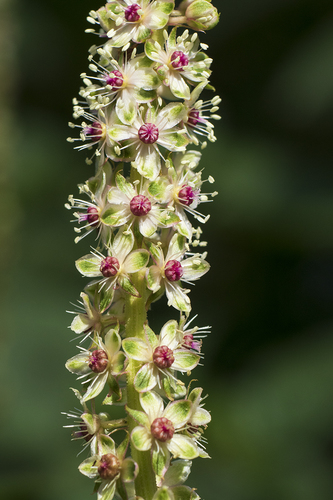
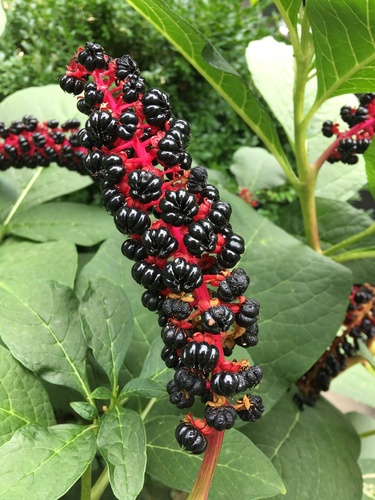
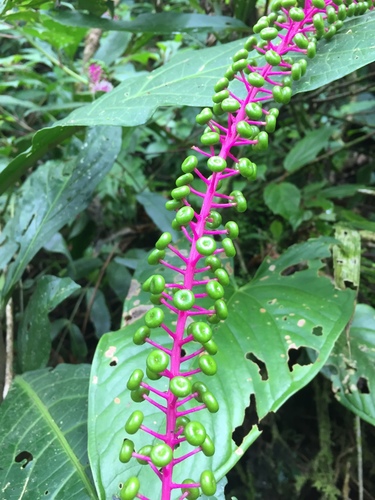
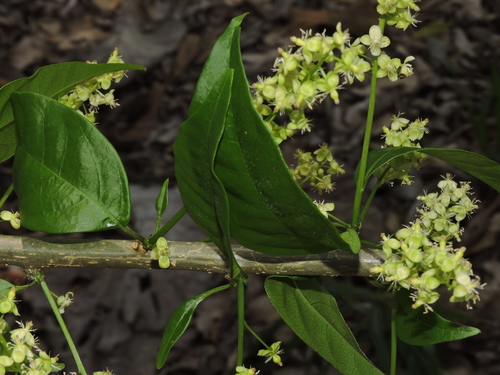
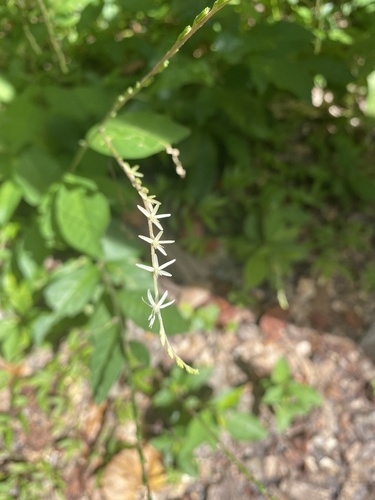
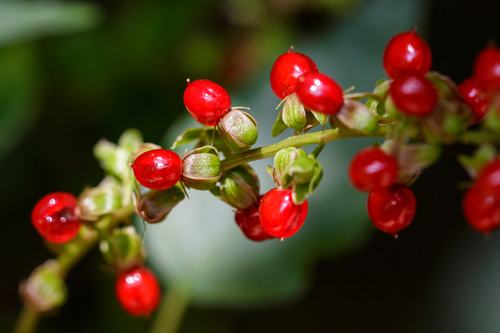
Rivina humilis L., commonly called pigeonberry, is an erect, vine-like evergreen perennial herb that grows 0.4–2 m (1.3–6.6 ft) tall. Its leaves can reach up to 15 cm (5.9 in) long and 9 cm (3.5 in) wide, attached by petioles 1–11 cm (0.39–4.33 in) in length. It produces flowers on racemes 4–15 cm (1.6–5.9 in) long; these racemes have peduncles 1–5 cm (0.39–1.97 in) long and individual flower pedicels 2–8 mm (0.079–0.315 in) long. The flower sepals are 1.5–3.5 mm (0.059–0.138 in) long, and range in color from white or green to pink or purplish. Its fruit is a glossy, bright red berry with a diameter of 2.5–5 mm (0.098–0.197 in). This species grows in forests, thickets, shell middens, hammocks, roadsides, and disturbed areas, at elevations ranging from sea level up to 1,700 m (5,600 ft). It needs less than partial sun and is tolerant of full shade, as well as tolerant of salt spray and saline soils. It is classified as invasive in New Caledonia, where it was likely introduced in 1900. It is considered a weed in Queensland, Australia, where it has naturalised. It is also naturalised on the Cocos Islands, Réunion, Norfolk Island, Fiji, Tonga, French Polynesia, Hawaii, India, and the Galapagos Islands. Ecologically, R. humilis acts as a host plant for the caterpillars of Goodson's greenstreak, Cyanophrys goodsoni. Pigeonberry is cultivated as an ornamental across warm regions of the world, and valued as a shade-tolerant groundcover. It is also grown as a houseplant and in greenhouses. Historically, juice from its berries was used to make dye and ink. The berries contain a pigment called rivianin (or rivinianin), which has the IUPAC name 5-O-β-D-Glucopyranoside, 3-sulfate, CAS number 58115-21-2, and molecular formula C24H26N2O16S. This pigment is very similar to betanin, the pigment found in beets. The fruit also contains the betaxanthin humilixanthin. Testing of berry juice in male rats has resulted in reports that it is safe for consumption.