About Rissa tridactyla (Linnaeus, 1758)
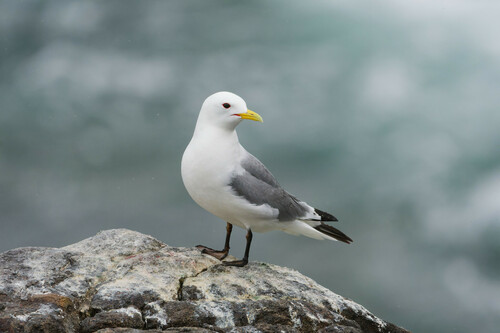
The black-legged kittiwake (Rissa tridactyla) is a seabird species that belongs to the gull family Laridae. This species was first described by Carl Linnaeus in his landmark 1758 10th edition of Systema Naturae, originally named Larus tridactylus. Its English common name comes from its characteristic shrill call, transcribed as 'kittee-wa-aaake, kitte-wa-aaake'. In North America, the name black-legged kittiwake is used to distinguish this species from the red-legged kittiwake, but in Europe, where it is the only member of the genus Rissa, it is often simply called kittiwake. The black-legged kittiwake is a coastal bird found across arctic to subarctic regions of the world. It occurs along all northern Atlantic coasts from Canada to Greenland, and along northern Pacific coasts from Alaska to the coast of Siberia. Its wintering range extends further south, reaching from the St. Lawrence to the southern coast of New Jersey, and also includes areas in China, the Sargasso Sea, and off the coast of West Africa. There are two recognized subspecies of black-legged kittiwake: Rissa tridactyla tridactyla is found on Atlantic coasts, while Rissa tridactyla pollicaris occurs on Pacific coasts. Among all gulls, kittiwakes are the most pelagic, with the possible exception of Sabine's gull. Kittiwakes are almost exclusively found at sea except during the breeding season, which runs from May to September. During breeding season, they nest on the sheerest sea cliffs. They are rarely found inland, though occasional vagrant individuals can turn up far inland, even in central Asia more than a thousand kilometers from the sea. For the rest of the year, kittiwakes spend most of their time flying out of sight of land. Kittiwakes are primarily pelagic piscivorous birds. Their main food source is fish, though they also eat invertebrates including copepods, polychaetes, and squid, especially when fish is less available. Their diet is quite variable due to their wide geographic range. In the Gulf of Alaska, their diet typically includes Pacific capelin, Pacific herring, Pacific sand lance, and many other species. In the United Kingdom, European kittiwakes rely mostly on sandeels. In 2004, the kittiwake population on the Shetland Islands, along with local murre (guillemot) and tern populations, completely failed to reproduce successfully after a collapse in local sandeel stocks. Like most gulls, kittiwakes forage at the water surface, catching prey while in flight or resting on the water. Throughout winter, kittiwakes spend all of their time at sea foraging. Unlike some gull species, they do not scavenge at landfills. Kittiwakes' foraging style is often compared to terns' foraging strategy, because they frequently hover and quickly dive headfirst at the water surface. It is common for kittiwakes to follow whales, as they feed on fish fragments expelled by these large marine mammals. Fishermen and commercial fishing boats frequently see large groups of kittiwakes, often mixed with other gull species and terns, hovering around their vessels to feed on scraps discarded in wastewater or thrown overboard. Few studies have focused on the water needs of kittiwakes, but they seem to prefer salt water over fresh water. Captive kittiwakes are known to refuse fresh water, but will readily drink salt water.