About Riparia riparia (Linnaeus, 1758)
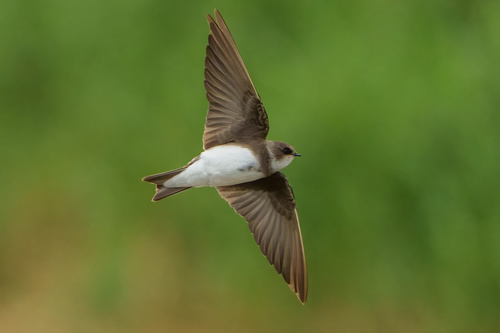
This species, the sand martin, has the scientific name Riparia riparia (Linnaeus, 1758). Adult sand martins are brown on their upper bodies, white on their under bodies with a narrow brown band across the breast, and have black bills and brown legs. Juvenile sand martins have rufous tips on their coverts and rufous margins on their secondaries. This species can be distinguished from similar swallow species such as the common house martin (Delichon urbicum), American cliff swallow (Petrochelidon pyrrhonota), and tree swallow (Tachycineta bicolor) by its brown back, breast band, white throat, small size, and quick jerky flight. Other members of the genus Riparia are more similar in appearance. Sand martins generally only share a range with these other Riparia species within their wintering range, though the sand martin and pale martin have overlapping breeding ranges in central Asia. Both species form shared mixed colonies in this area without interbreeding. The banded martin (Neophedina cincta) of sub-Saharan Africa has a very similar plumage pattern to the sand martin, but is markedly larger, with nearly double the body weight. Standard measurements for the sand martin are: length 12–13 cm (4.7–5.1 in), wingspan 26.5–29 cm (10.4–11.4 in), and weight 11–16 g (0.39–0.56 oz), with weights reaching up to 19.5 g (0.69 oz) before migration. When in flight, sand martins produce a continuous gravelly twittering song. After birds settle into the roost, this song becomes a conversational undertone. A harsh alarm call is given when a passing falcon, crow, or other suspected predator is spotted, triggering group defensive action to drive the predator away. Linnaeus had already recorded the breeding habits of this species, noting its habitat in Europe as sheer sandy hills with winding burrows. Sand martins have been observed to especially favour loess ground for nesting. Throughout the year, sand martins are generally found near large bodies of water such as rivers, lakes, or even the ocean. In Britain, the sand martin is the first species in its family to arrive at its breeding grounds, coming from the middle of March, one or two weeks earlier than the barn swallow. In northern Ohio, sand martins now arrive in large numbers by mid-April, about 10 days earlier than they did 100 years ago. When they first arrive, they fly alone over large bodies of water searching for early-emerging flies. Later groups join other swallow species, but the birds stay at these large bodies of water and do not move to their nesting sites for a period of time that varies with weather conditions. Sand martins depart their breeding grounds early, especially from their more northerly breeding sites. In August, nightly roost gatherings grow enormously in size, though numbers are highly irregular due to the arrival and departure of migrating birds passing through the area. They are essentially completely gone from their entire breeding range by the end of September. The sand martin's diet consists of small insects, mostly gnats and other flies with aquatic early life stages. Sand martins are social when nesting; between a dozen and several hundred pairs will nest close to each other, depending on available space. Nests are located at the end of tunnels that range from a few inches to three or four feet long, which the birds bore into sand or gravel. The actual nest is built from straw and feathers arranged in a small chamber at the end of the burrow, and it quickly becomes infested with parasites. Four or five white eggs are laid around mid-to-late May, and a second brood is usual for all breeding sites except the most northerly ones. Globally, the sand martin is not rare. The IUCN classifies it as a species of least concern, though it notes that the global population is decreasing. The species has national and local protections in some areas, because certain populations have declined or face threats from habitat loss and habitat fragmentation. In Canada, it is listed as Threatened under Schedule 1 of the federal Species at Risk Act (SARA), because 98% of the Canadian population has been lost over the past 40 years. It is considered threatened in California, where its populations are located in the Sacramento Valley and at two coastal sites: Año Nuevo State Park and Fort Funston.