About Riparia cincta (Boddaert, 1783)
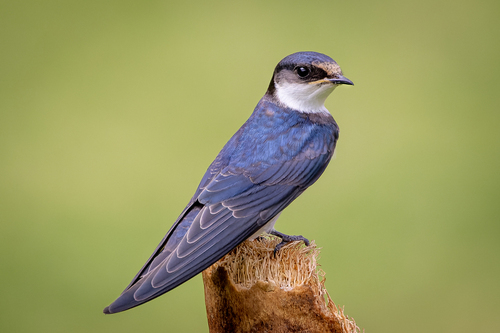
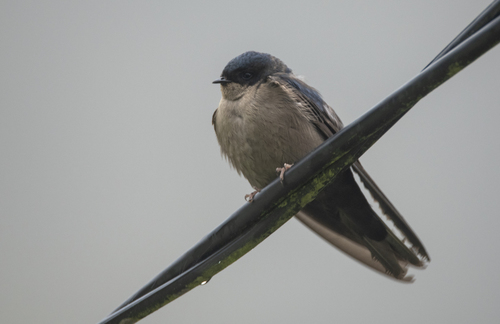
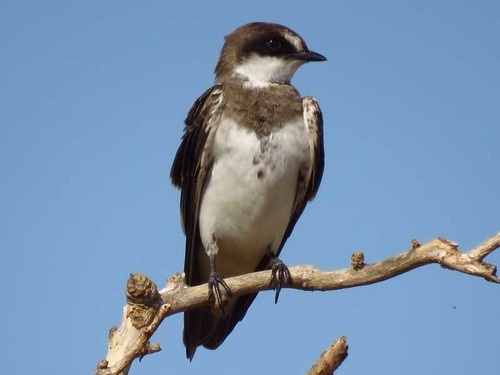
Riparia cincta, commonly called the banded martin, is 15–17 cm (5.9–6.7 in) long. It has earth-brown upperparts, with the exception of a white stripe above the eye. Its underparts and underwing coverts are white, it has a dark brown breast band, and sometimes a thin dark line across the vent. Males and females have similar plumage. Young birds have a paler breast band and golden tips on their upperpart feathers. It can be easily distinguished from the smaller sand martin by its square tail and white underwings, and from the brown-throated sand martin by its white throat. It is less gregarious than these two species, and is typically seen in pairs or small flocks. Subspecies of Riparia cincta differ in size and in the plumage tones of the upperparts or breast band. The nominate subspecies R. c. cincta found in southern Africa is the palest form. The banded martin occupies open habitats including farmland, grassland, and savannah, usually located near water. It breeds across Africa from Cameroon and Zaire to Ethiopia, extending south to the Cape in South Africa. It is not present in the driest regions of western South Africa and southern Namibia. The southern nominate subspecies found in South Africa and Zimbabwe is migratory, and winters further north, particularly in the west, sometimes moving as far as Gambia. The subspecies N. c. xerica also leaves its drier breeding grounds in Botswana and northern Namibia during the southern winter. Other subspecies make local or altitudinal movements that usually depend on rainfall patterns. This species has slow, erratic flight and frequently perches. Its diet is made up of insects, which it usually catches while flying over grassland. Its flight call is che-che-che, and its song is a twittering jumble of chip choop sounds. Unlike other members of its genus, the banded martin does not nest colonially. Its nest sits at the end of a 60–90 cm (24–35 in) long tunnel that the birds usually excavate into a natural sand bank or earth mound. The nest itself is a lining of straw and feathers in a chamber at the end of the burrow. Both parents incubate the clutch of two to five white eggs.