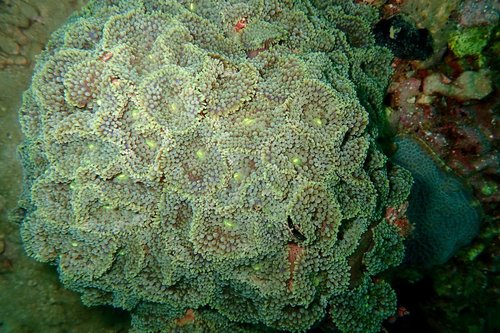
About Ricordea florida Duchassaing & Michelotti, 1860
Morphology: Ricordea florida is a skeletonless coral that shares the same internal anatomical structure as corals in the order Scleractinia. Its small body is cylindrical, with a flat, disk-shaped basal end that acts as a foot. The apical end is an oral disk that holds one or more mouths. These mouths are centered among short, rounded tentacles that carry cnidocytes; the sting from these cells contains paralytic neurotoxins. This sting is used to subdue prey to make ingestion easier through the mouth, and it also works as a defense against enemies. The stinging power of this species is weaker than that of most corals. Ricordea florida can grow up to 7.5 cm in diameter. Its fleshy body and tentacles appear in a wide range of colors: purple, orange, green, blue, and yellow. The tentacle tips and mouth may be one or more different colors than the rest of the organism. The color of Ricordea florida changes based on multiple factors, including the depth of its habitat, water temperature, season, and other environmental conditions.
Habitat and distribution: Ricordea florida lives on the inner parts of reefs, most commonly in shallow water, rocky areas, and pools. It occurs either alone or in small groups. Its known range includes the Atlantic Ocean, the Caribbean Sea, and the Gulf of Mexico.
Reproduction: This coral can reproduce asexually through two different mechanisms. The first is fission, in which the coral splits along its mouth to produce a genetic clone. The second is laceration, where new individuals develop from small particulates released from the coral’s foot. Sexual reproduction produces a free-swimming larva called a planula, which develops into a new individual once it settles onto the seabed.
Feeding: Like many other corals, Ricordea florida hosts symbiotic zooxanthellae algae. These algae carry out photosynthesis to produce oxygen and sugars, which the coral then uses. In turn, zooxanthellae feed on the coral’s waste catabolites, particularly phosphorus and nitrogen. Ricordea florida gets nutrition both from the organic products produced by its zooxanthellae, and from zooplankton or fish it catches with its tentacles, as well as dissolved organic matter present in the surrounding water.

