About Richardsonius egregius (Girard, 1858)
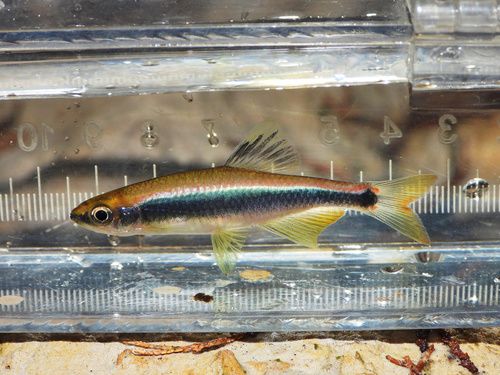
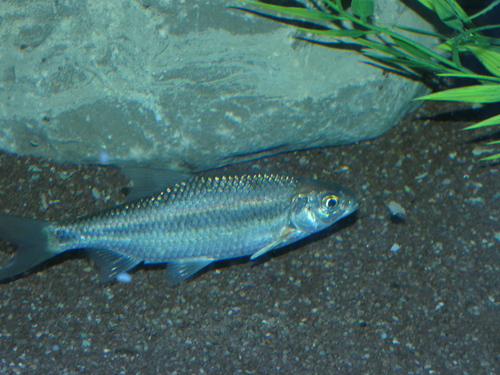
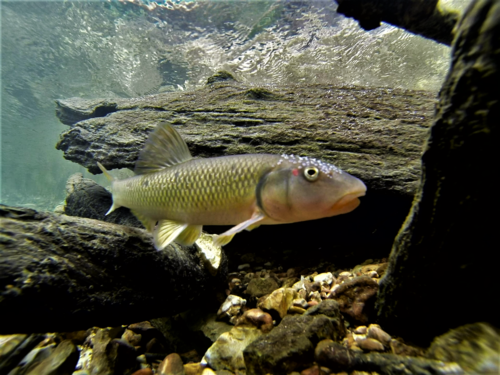
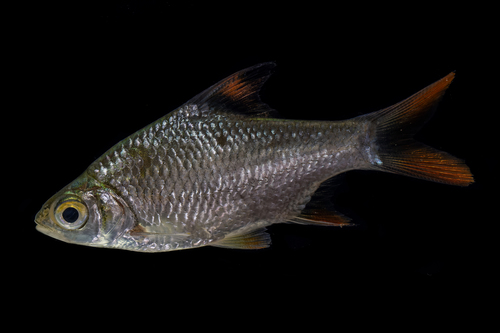
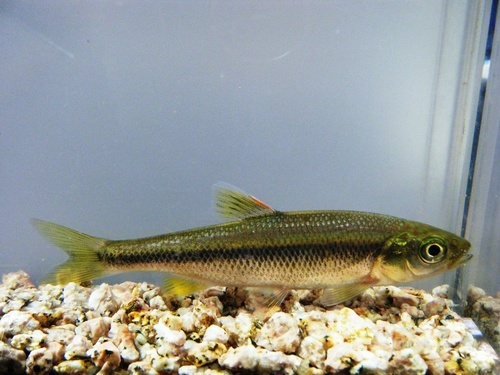
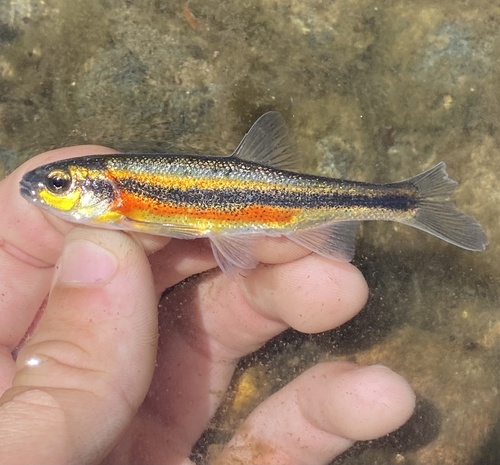
Lahontan redsides, scientific name Richardsonius egregius (Girard, 1858), are most well known for their distinctive breeding coloration: each flank has a bright red stripe bordered by yellow. Breeding males have a darker red stripe than breeding females. When not spawning, the stripe may still be visible, but the red is faded, creating a gradual transition from the fish's olive-colored back to its silvery underside. These are slender, agile fish. Their dorsal fin has 7 to 8 rays, and their anal fin has 8 to 10 rays. Their pectoral fins are moderately long, with tips that reach almost to the bases of the pelvic fins. The tail is deeply forked. Relative to their body size, they have small mouths and hooked pharyngeal teeth. They also have an S-shaped intestine and stubby gill rakers. The maximum recorded length of this species is 17 cm, while the average length of a mature adult is 8 cm.
This fish is found in the eastern Sierra Nevada mountain range of California and in western Nevada, occurring across most basins within this range. It inhabits the Lahontan, Humboldt, Walker, Carson, Truckee, Susan, Quinn, and Reese river systems, as well as Tahoe, Pyramid, and Walker lakes. Lahontan redsides occupy a wide variety of habitats across their range, from fast-flowing mountain tributaries to large rivers and all habitat types in between. They prefer areas with rocky bottoms, and also live in lakes. They tend to congregate near cover, including wharves, boulders, submerged logs, and other objects. They occupy all stream niches, ranging from fast riffles to slow, deep pools: juveniles prefer slower water and eddies, while adults prefer swifter water in river main channels. In lakes, they are most commonly found near shore along the margins. In Lake Tahoe specifically, they prefer the littoral zone unless water temperatures drop below 10 degrees Celsius. At this temperature, they move to deeper, warmer water, where they stay mostly inactive near the rocky bottom.
Lahontan redsides typically take three to four years to mature and reach spawning age, though some individuals are able to spawn at two years of age. When mature individuals reach the spawning season, they develop breeding tubercles on their body and head. Males develop more tubercles overall, and also grow additional tubercles on their pectoral fins. The spawning season runs from late May to August, when water temperatures are between 13 and 24 degrees Celsius. The Lake Tahoe population generally spawns in June and July, while populations east of Lake Tahoe usually spawn earlier, from May to June. Spawning fish seek out shallow water, either at lake margins or in stream pools with sand and gravel substrates. In lakes like Lake Tahoe, Lahontan redsides sometimes migrate up small tributaries to spawn. To start the spawning process, they form loose, swirling groups of 20 to 100 fish just above the stream or lake bottom. Egg laying and fertilization occur when smaller subgroups of fish swim down and press themselves against the bottom; after release, the eggs adhere to rocks and crevices. This species is known to hybridize with Gila bicolor (Tui chub) and Rhinichthys oculus (Speckled dace).