About Richardsonius balteatus (Richardson, 1836)
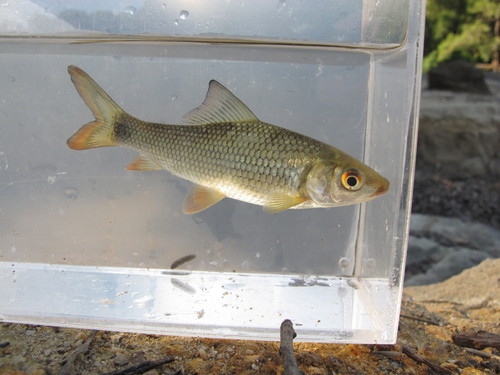
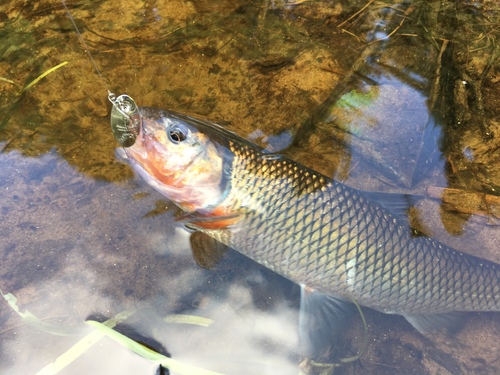
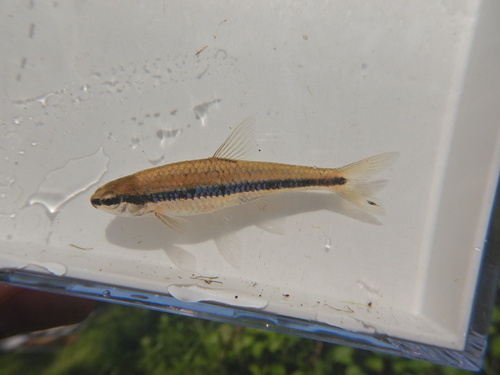
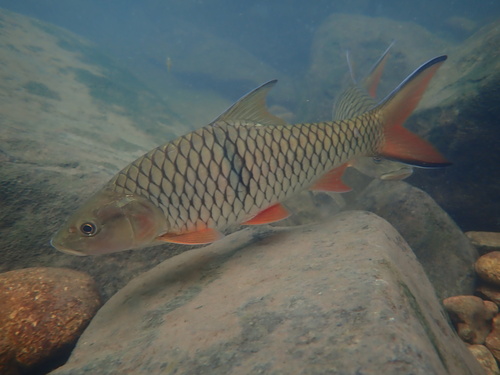
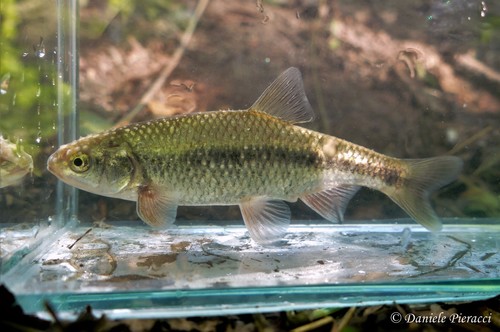
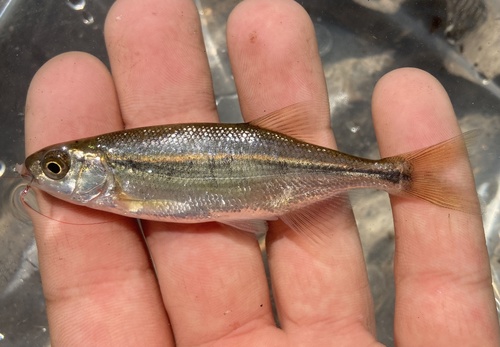
Morphology: The redside shiner (Richardsonius balteatus) has silver sides and an olive or brown dark color on its back. It has a thick black stripe and a smaller red or gold stripe running along its lateral line. During spring spawning, additional red color develops on the lower half of the front of the body, particularly in males. This species has a deep, laterally compressed body, a forked homocercal tail, and a complete, decurved lateral line. Its anal fin contains 10 to 24 rays, while its dorsal fin contains 8 to 12 rays; neither fin has spines. The fish has between 52 and 67 lateral line scales. Most adult specimens measure 55 to 80 millimeters (2.2 to 3.1 inches) in length. It has a conical snout, no barbels, a terminal mouth, and pharyngeal teeth arranged in patterns of 2,4-4,2 or 2,5-5,2. Its eyes are relatively large for its body size. Morphometric and meristic traits differ between the two recognized subspecies, R. b. balteatus and R. b. hydrophlox.
Habitat and distribution: Redside shiners typically live in cold water habitats including ponds, lakes, pools, backwaters of large rivers, small streams, and shallow edges of lakes and ponds. Their native range is mostly located west of the Rocky Mountains in North America, with the exception of the Peace River in northern British Columbia and Alberta. The native range extends south through most of Washington, Oregon and Idaho, western Montana, northern Nevada, and the Bonneville Basin in Utah. The species has been introduced to northwestern Colorado, southwestern Wyoming, the upper Missouri River drainage in Montana, and reservoirs outside its native range in southern Utah. Many of these introductions occurred via illegal bait bucket transfers, most often carried out by well-meaning anglers hoping to increase forage for sport fish, though these introductions are not ecologically sound in most cases. As aggressive colonizers, redside shiners spread rapidly through waters that meet their ecological niche requirements.
Subspecies R. b. balteatus is distributed across Washington, Oregon, northern Idaho, western Montana, British Columbia, and the Peace River system in northern Alberta. Subspecies R. b. hydrophlox is found in Utah's Bonneville Basin, waters of the Snake River Plain above Shoshone Falls, and a separate disjunct population in the Malheur region of southeast Oregon. It is widely accepted that geological processes (including river capture and lake spillover events such as the Bonneville flood) and changing climate (including survival in and expansion from Pleistocene refugia) shaped this species' current geographic distribution, as described by Hubbs and Miller (1948), Minckley et al (1981), and McPhail and Lindsey (1981).
Life cycle: The redside shiner is a short-lived fish. It reaches maturity around age 2, has an average lifespan of 5 to 6 years, and has been recorded living up to 8 years. They spawn from spring into early summer. Their eggs are coated in a sticky adhesive that lets them attach to rocks and vegetation. Their diet includes aquatic and terrestrial invertebrates, plus the eggs and fry of other fish species. They are an intraguild predator, meaning they act as both predators and prey for larger fish species such as salmon.