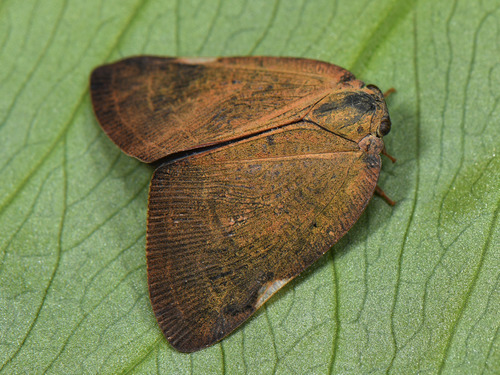
About Ricania shantungensis Chou & Lu, 1977
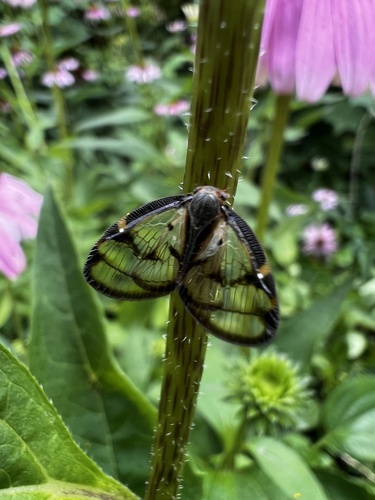
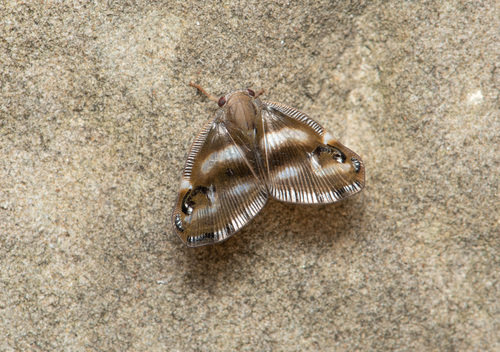
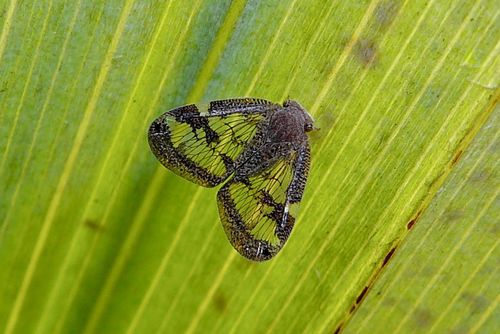
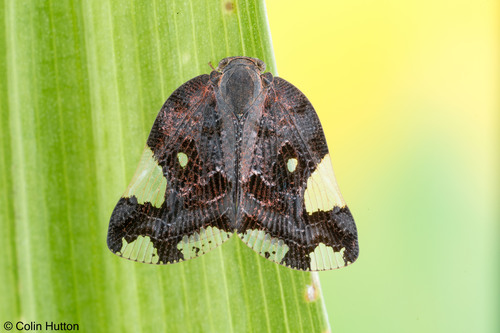
This species, currently recognized as Ricania shantungensis Chou & Lu, 1977 (also referenced as Pochazia shantungensis in the original source material), shows sexual dimorphism in body size: males are smaller than females. For males, body length from the vertex to the tip of the genitalia measures 7.5–7.8 mm, and from vertex to the tip of the forewings it measures 14.0–14.4 mm. For females, body length from the vertex to the tip of the genitalia measures 8.3–8.8 mm, and from vertex to the tip of the forewings it measures 15.0–15.3 mm. Overall body color ranges from dark brown to black. The vertex, frons, clypeus, rostrum, and eyes are typically brown to dark brown, while the pronotum, mesonotum, and thorax are black. The dark brown forewings have an elliptical white spot on the costal margin, located roughly two-thirds of the way from the wing base. The posterior margins of the abdomen segments are yellow. These planthoppers lay eggs in a zigzag pattern, and cover the eggs with white wax filaments. Eggs can be laid on trees on branches of any height and any orientation. This species is commonly found in Zhejiang Province and eastern coastal regions of Shandong Province, China. It is only classified as a pest within Zhejiang Province. Starting in 2010, it has been reported as an invasive species in coastal areas of Southern Korea, where annual temperature and precipitation conditions are similar to its native range. It was first detected in European Turkey and Southern France in 2018, and was later detected on the Asian side of Istanbul across the Bosphorus. It inhabits a wide variety of landscape types including cities, orchards, agricultural fields, and forests, and reaches higher population densities in mountain regions and valleys.