About Ribes viscosissimum Pursh
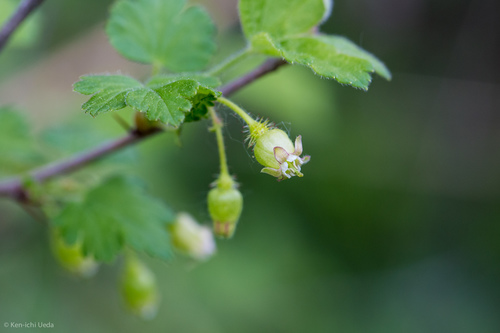
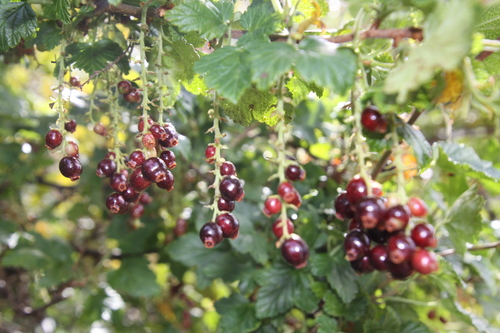
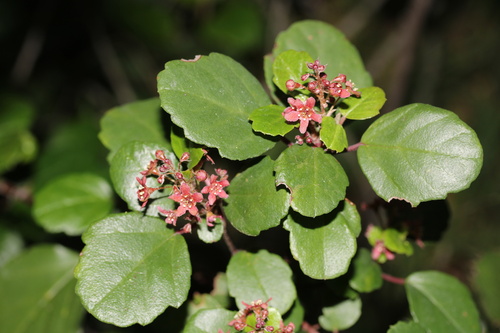
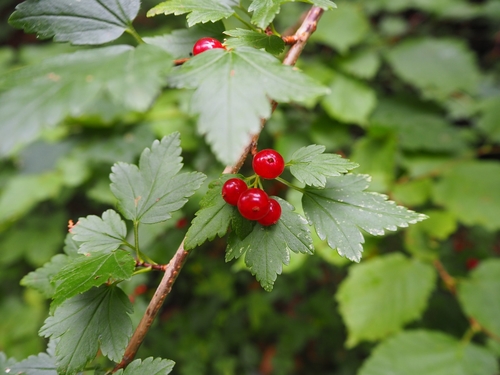
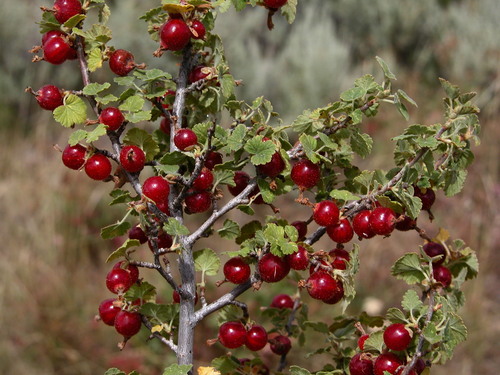
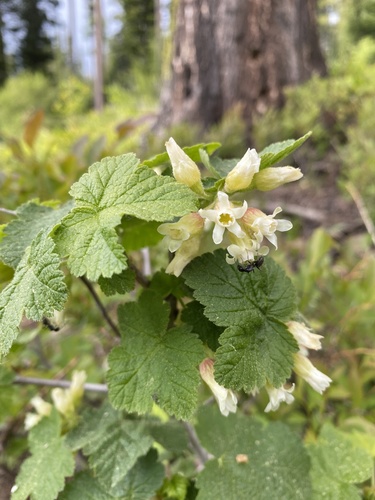
Ribes viscosissimum Pursh is a perennial dicot plant that grows 1 to 2 metres (3+1⁄4 to 6+1⁄2 ft) tall. Its stem is covered in sticky glandular hairs, and does not have spines or bristles. The plant is resinous and fragrant. Its leaves have thick, rough blades divided into three similarly sized lobes with rounded, toothed tips. Leaf blades typically measure 8 cm (3+1⁄8 in) long, and leaf petioles can reach up to 10 cm (4 in) long. It blooms in early summer, producing inflorescences that are erect or drooping clusters holding 4 to 15 bell-shaped flowers. The flowers have five sepals that are whitish, green, or pink-tinged, which resemble a corolla at their tips and sometimes become reflexed. Whitish petals surround the flower's stamens and stigmas. The fruits are blue-black black berries covered in bluish wax, grow up to 1 cm (3⁄8 in) long, and are very gummy; they are described as unpalatable. This species is native to North America, specifically native to the Pacific Northwest, Columbia Plateau, Great Plains, Great Basin, and southwestern regions of western North America. It grows at montane to lower subalpine elevations, in habitats including streambanks, damp to dry woods, sagebrush plateaus, and rocky slopes. It is found in large quantities in the U.S. states of Idaho, Oregon, and Washington. Specific recorded locations include: Grant County, Oregon, in the Strawberry Wilderness on Slide Basin trail #372, on the lower switchback of the trail to Slide Lake below the ridge between Strawberry and Slide Basins, at an elevation of 2,020 m (6,620 ft); Bonner County, Idaho, at Priest Lake State Forest in the Selkirk Mountains, Laclede, along Riley Creek Road, about 2.5 miles up Manley Creek Road; Blaine County, Idaho, on the trail to Amber Lakes from the West Fork of North Fork of Big Wood River, north of Ketchum; and Caribou County, Idaho, in Caribou National Forest along Forest Road 107, about 2.5 air miles southwest of Stump Peak, accessed from Highway 34 by going up road 107 to Valley Creek. Multiple bumblebee species have been reported as pollinators of this species or its genus where their geographic ranges overlap: Bombus vagans, B. bifarius, B. centralis, B. fervidus, B. flavifrons, B. huntii, B. melanopygus, B. mixtus, B. nevadensis, B. terricola, B. sitkensis, and B. occidentalis.