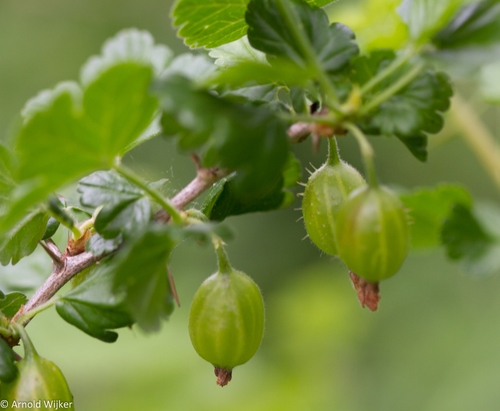
About Ribes uva-crispa L.
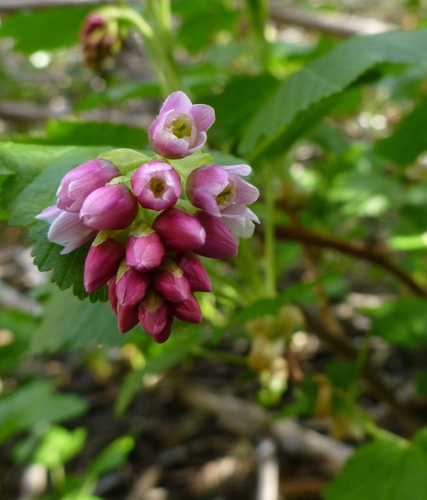
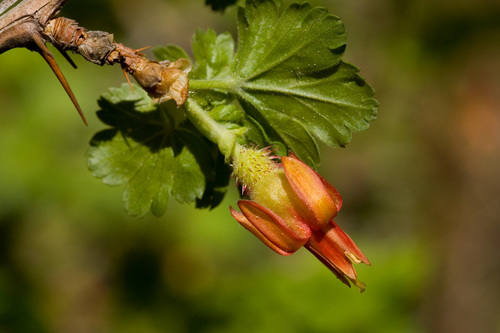
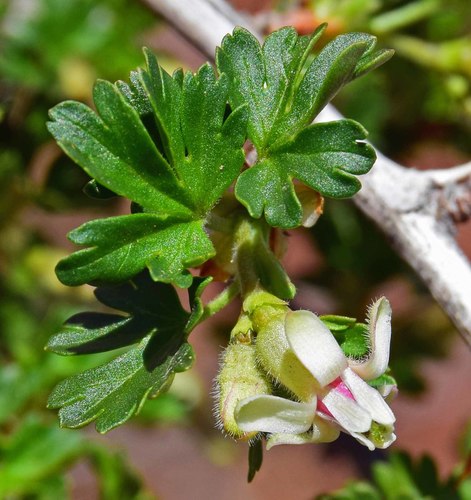
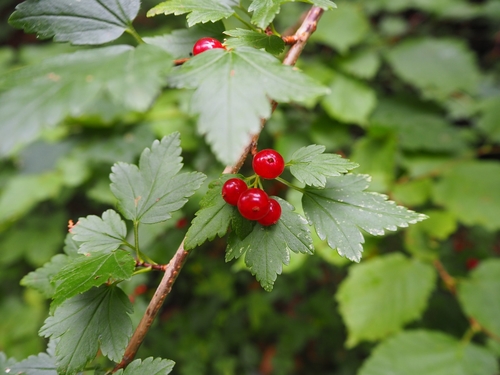
Ribes uva-crispa L., commonly known as gooseberry, is a straggling bush that reaches 1.5 metres (5 feet) in both height and width. Its branches are thickly covered in sharp spines, which grow singly or in diverging clusters of two or three from the bases of short spurs or lateral leaf shoots. Bell-shaped flowers grow singly or in pairs, emerging from among rounded, deeply crenated leaves that have 3 or 5 lobes. The species produces berry fruits; wild gooseberries have smaller berries than cultivated varieties, but wild berries often have good flavor. Berries are usually green, though red, purple, yellow, and white variants exist.
This species is native to Europe, the Caucasus, and northern Africa. Its exact native distribution is unclear, because it has often escaped from cultivation and become naturalized in new areas. For example, in Britain, some sources classify it as native, while others consider it an introduced species. It is also occasionally naturalized in scattered locations across North America. It grows naturally in alpine areas and rocky forests.
Gooseberry cultivation was popular in the 19th century; a description from 1879 outlines its cultivation history. In Britain, the plant is often found in copses, hedgerows, and around old ruins, but it has been cultivated for so long that it is difficult to tell wild bushes apart from feral (escapee) bushes, or to confirm its status as part of Britain's native flora. While it is now common on some lower slopes of the Alps of Piedmont and Savoy, it is uncertain whether the ancient Romans knew of the gooseberry, though it may be vaguely referenced in a passage of Pliny the Elder's Natural History. The hot summers of Italy, both in ancient times and the present, are unfavorable for cultivating gooseberries.
Though gooseberries are abundant in Germany and France today, the plant does not appear to have been widely grown there during the Middle Ages. However, wild gooseberry fruit was valued medicinally for the cooling properties of its acidic juice to treat fevers. The old English regional name Fea-berry, which still survives in some provincial dialects, shows the plant was similarly valued for this purpose in Britain, where it was planted in gardens at a comparatively early date. William Turner described gooseberry in his Herball, written around the middle of the 16th century, and a few years later it was mentioned in one of Thomas Tusser's rhymes as a common garden plant. Improved varieties were likely first developed by skilled Dutch gardeners; the Dutch name for the fruit, Kruisbezie, may have been corrupted to form the modern English common name. Towards the end of the 18th century, gooseberry became a popular plant for cottage horticulture, especially in Lancashire, where working cotton spinners bred many new varieties from seed, focusing their efforts on increasing the size of the fruit.