About Ribes sanguineum Pursh
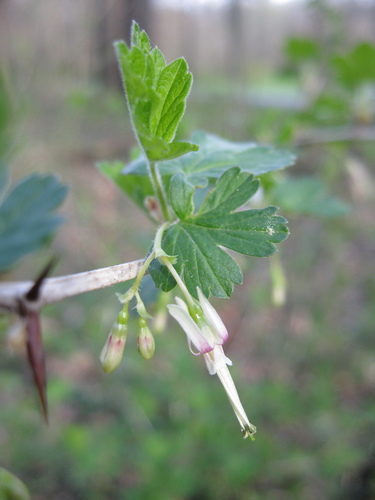
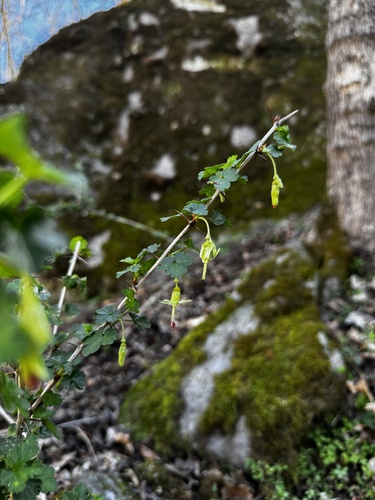
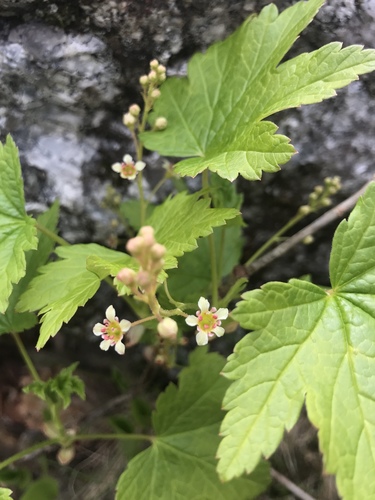
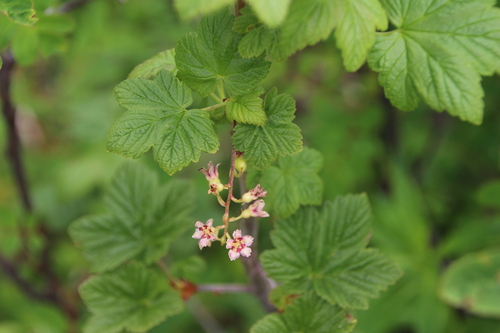
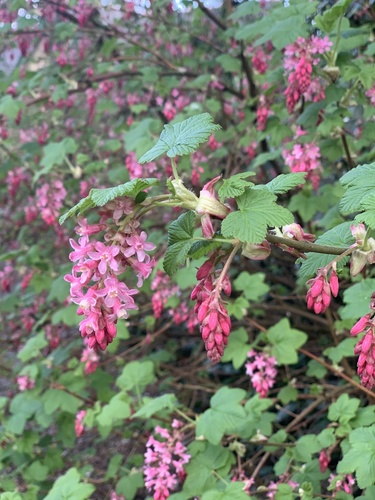
Ribes sanguineum Pursh, commonly called red-flowering currant, is a deciduous shrub that grows to 3 metres (10 feet) tall and broad. It is naturally multi-stemmed with an upright-arching to rounded growth habit, though it can also be grown in tree form. Its bark is dark brownish-grey, marked with prominent paler brown lenticels. The leaves are alternately arranged, simple, 2–7 centimetres (1–3 inches) long and broad, and palmately divided into five lobes. Young, newly emerged spring leaves carry a strong resinous scent. Flowers emerge in early spring at the same time as new leaves, growing on dangling racemes 3–7 cm (1–3 in) long that hold 5–30 individual flowers; each flower is 5–10 millimetres (1⁄4–3⁄8 in) in diameter, with five petals that can be red, pink, or white. The fruit is a dark purple oval berry about 1 cm (3⁄8 in) long with an insipid taste. It is native to the western United States, Canada, and Mexico. In western British Columbia, Washington, and Oregon, it is widely distributed in moist regions west of the Cascades. In California it is restricted to coastal areas, ranging as far south as Santa Barbara County. In Mexico, it only occurs on the Pacific island of Guadalupe, where it may already be extirpated. While its conservation status is secure across most of its native range, it is critically imperiled in Idaho, where it is only found rarely in Bonner, Kootenai, Benewah, and Adams counties. It is widely cultivated and has become naturalized throughout temperate Europe and Australasia. The species' early spring nectar is used by hummingbirds and butterflies. Butterfly and moth larvae feed on its leaves, deer and elk occasionally browse its leaves, and its berries are eaten by birds and small mammals. Its branches provide nesting habitat for birds. Ribes sanguineum is a host for white pine blister rust, which led to organized eradication efforts for the species in the early to mid-20th century. Starting in the 1920s, the entire Ribes genus was under federal restriction in the United States; the ban was lifted in 1966, due to increased resistance among both Ribes and Western white pine populations. Red-flowering currant is shade tolerant, but prefers sunny sites. It tolerates drought well, but grows best in cool, moist conditions. R. sanguineum was introduced to cultivation in Britain in autumn 1826 by Scottish botanist David Douglas, from seeds he sent back during his explorations of the Pacific Northwest for the Royal Horticultural Society. It and its varieties and cultivars gained immediate popularity among English gardeners, and it remains a popular garden shrub today. It is valued for its brightly colored, scented early spring flowers, and for supporting birds and wildlife habitat. Numerous cultivars have been selected, with flower colors ranging from white to dark red. Three cultivars have received the Royal Horticultural Society’s Award of Garden Merit: 'Koja', 'Poky's Pink', and White Icicle (also known as 'Ubric'). The berries are edible but have poor flavor. Both indigenous and non-indigenous people use the berries for food, eating them fresh or dried, or processing them into jams, pies, juice, or syrup. The flowers can be used to infuse beverages, most notably spirits.