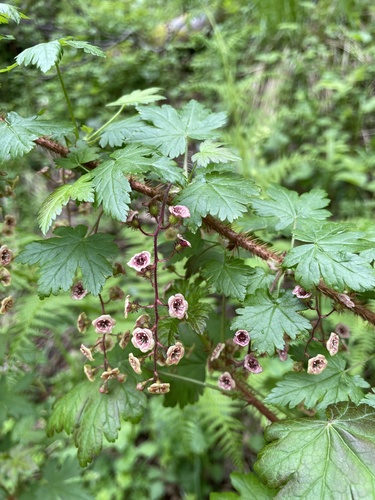
About Ribes oxyacanthoides L.
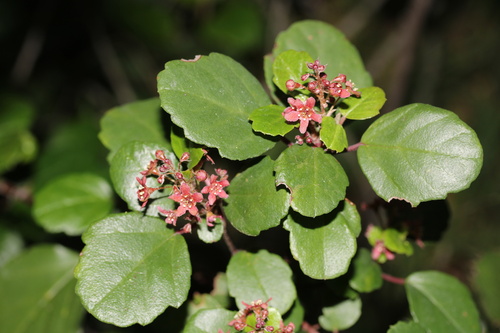
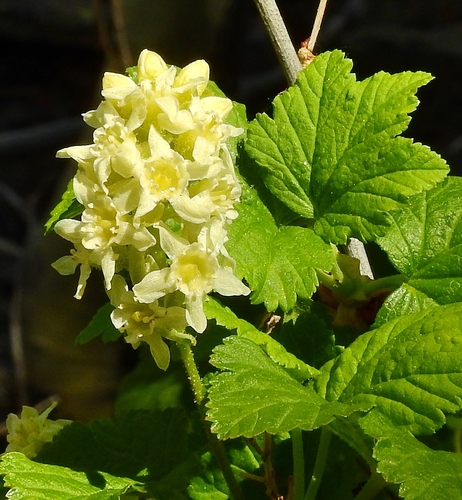
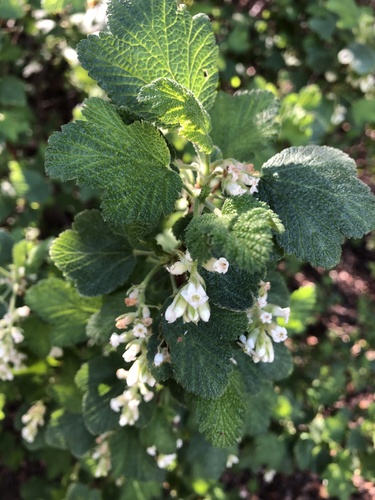
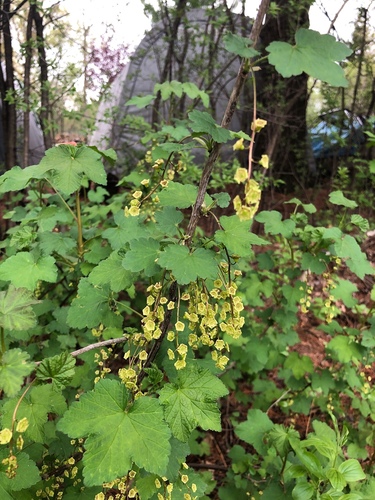
Ribes oxyacanthoides L. is generally a shrub that reaches 0.5 to 2 metres (1+1⁄2 to 6+1⁄2 ft) in height. The subspecies R. oxyacanthoides subsp. hendersonii is often smaller when mature. Its branches are covered in prickles, and spines up to 1.3 centimetres (1⁄2 in) long grow at stem nodes. The plant's deciduous leaves are 0.5 to 1.5 cm (1⁄4 to 5⁄8 in) wide, with a texture ranging from smooth to glandular-hairy. Flowers grow singly, in pairs, or in groups of three, and they are white or pinkish in color. The fruit is a palatable berry up to 1.6 cm (5⁄8 in) wide, and can be reddish, greenish, purple, or black.
This shrub is native to North America, ranging from Alaska through much of Canada to the western and north-central United States. It grows in many types of habitat, most commonly on riverbanks and in riparian woodlands. It also grows in boreal forest habitat, often among conifers at lower elevations. Some subspecies grow at higher elevations: the dwarf subspecies hendersonii can be found in mountain talus.
This plant acts as an alternate host for Cronartium ribicola, the pathogen that causes white pine blister rust, a pine tree disease. It is sometimes deliberately removed as part of efforts to control this rust disease. Small amounts of the shrub and its fruit are part of the diet of wildlife such as grizzly bears and mule deer.
Humans consider the berry somewhat palatable. Many Native American groups collected and stored the berries for food. For example, the Ojibwa cooked the berries and ate them with sweet corn, and also made them into preserves. The root of the plant was used medicinally.