About Ribes lobbii A.Gray
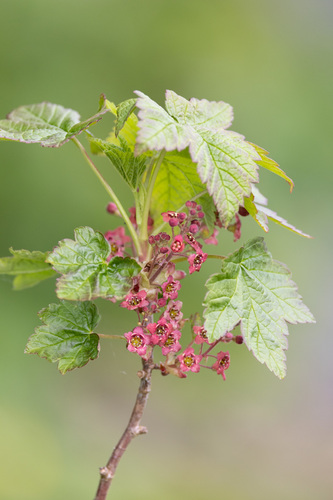
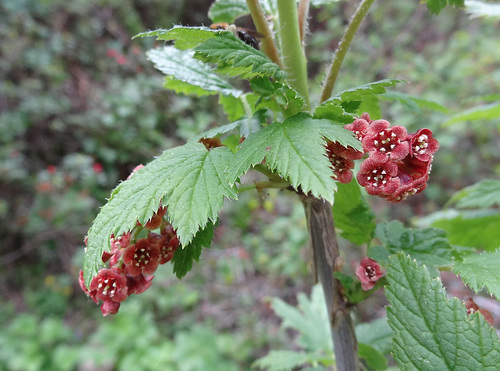
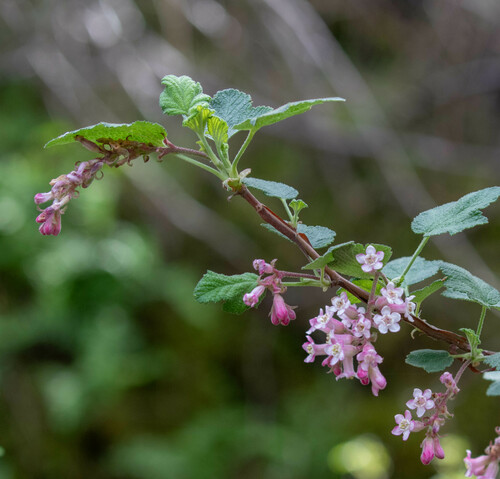
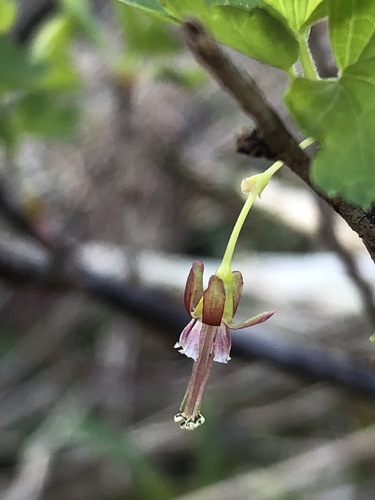
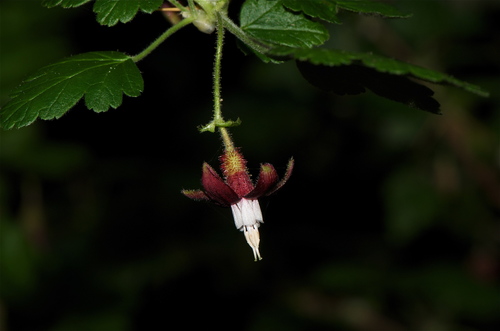
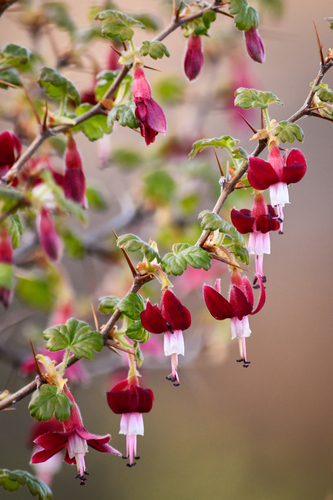
Ribes lobbii A.Gray is a deciduous, loosely branched shrub that reaches 0.5–1.5 metres (1+1⁄2–5 feet) in height. Its spreading stems are finely hairy, and typically bear three slender nodal spines 7–12 millimetres (1⁄4–1⁄2 inch) long. Its bark starts brown and matures to a deep greyish-red. Leaves grow on smooth stalks; each leaf is 1.3–2.6 centimetres (1⁄2–1 inch) long and 1.5–2.5 centimetres wide, arranged alternately. Leaf shapes are ovate with shallowly heart-shaped bases, shallowly cleft with deep toothing, and have 3–5 rounded lobes. The upper leaf surface is tacky and either hairless, or very sparsely haired; the lower surface is somewhat tomentous and glandular. Flowers develop in early summer, forming inflorescences of one or two flowers in a nodding raceme on stalks shorter than the leaves. Individual flower stalks measure 1.5–2 millimetres in length, and are densely bristled and glandular. White or light-pink petals are 4–6 millimetres long, broad and fan-like, and curl back away from the flower face toward the stem. The flower hypanthium is typically 3.5–5.5 millimetres long and shaped like a narrow bell. Anthers extend well beyond the petals. Calyces are red and hairy, with 10–13 millimetre long oblong, narrow, pointed lobes. Styles are smooth, fused to just below or just above the middle, and roughly equal in length to the stamens. Fruits of R. lobbii are round to elliptic berries 12–15 millimetres long. They are reddish-brown, roughly bristled, glandular, and unpalatable. R. lobbii prefers mesic to dry streambanks, rock outcrops, open woodlands and forests in the lowland and montane zones. It occurs more frequently in the drier Pacific portion of its range, where it is often a characteristic species, while it can be locally rare in the wetter Cordilleran region. It grows well in maritime to submaritime, cool mesothermal climates on very dry to moderately dry soils with moderate nitrogen content. It occurs sporadically or scattered in early-seral communities and open-canopy Douglas-fir forests on watersheds. This species, commonly called gummy gooseberry, is distributed sporadically across the Pacific Northwest: in the U.S. Pacific Northwest and British Columbia, Canada, where it favors foothill and subalpine zone forests and meadows. In British Columbia, it is locally common on the Gulf Islands and Vancouver Island, particularly the southern half of the island. In Washington state, it has been recorded in Wahkiakum, Skamania, Klickitat, Kittitas, Chelan, Pierce, Thurston and Clallam counties. In Oregon, it is found in the coastal counties of Curry, Douglas, and Lane, as well as the adjacent or nearby counties of Josephine, Jackson, Klamath, Benton, Linn, Jefferson, Marion, Wasco, Yamhill, Hood River, Multnomah and Columbia. In California, it is native to northern coastal coniferous and red fir forests in Del Norte, Humboldt and Mendocino counties, and ranges inland to Siskiyou, Trinity, Shasta and Glenn counties. Only a few samples have been recorded from Lake, Colusa and Modoc counties.