About Ribes laxiflorum Pursh
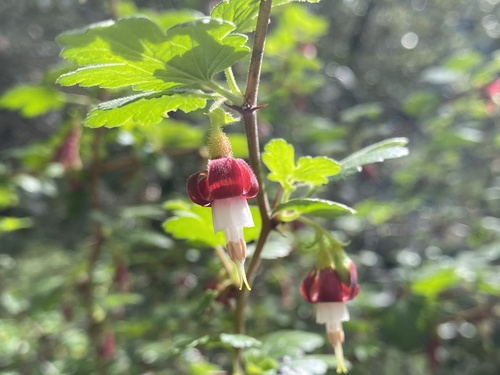
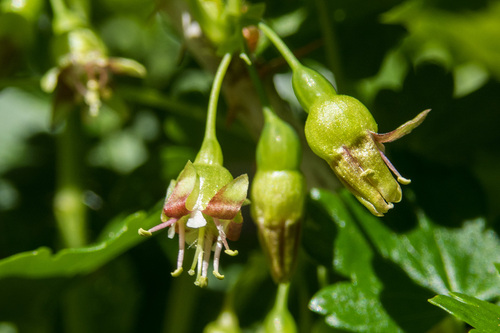
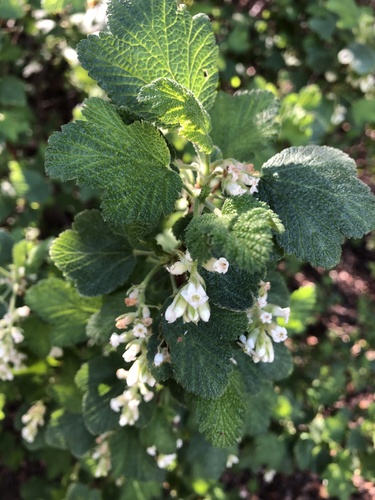
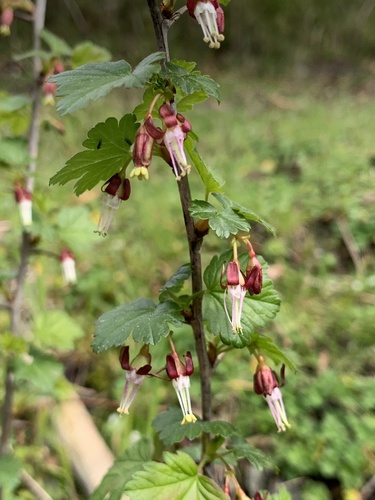
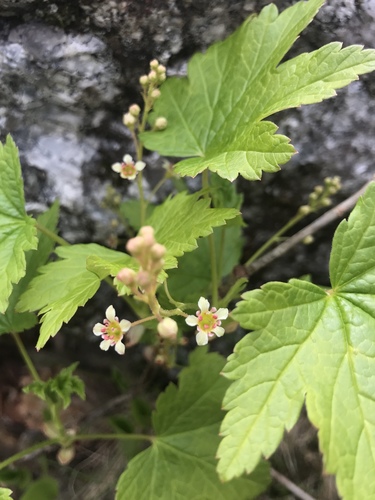
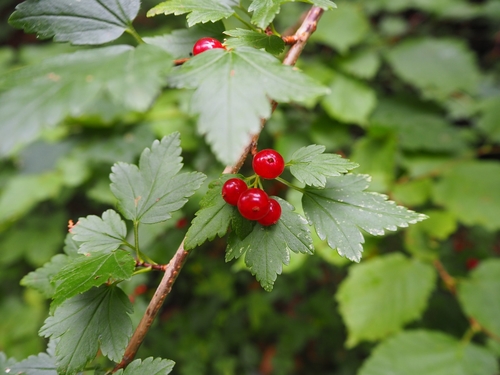
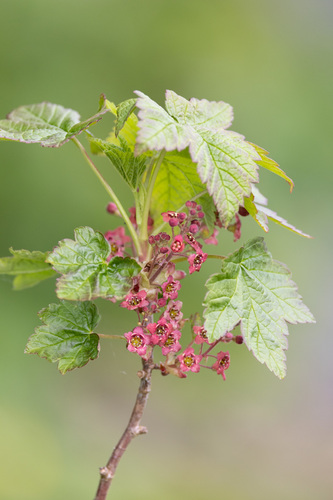
Ribes laxiflorum Pursh is a spreading, trailing shrub that usually reaches 0.5 to 1 meter (1½ to 3½ feet) in height. It can also grow in a somewhat vine-like form when growing in shaded areas with nearby supports, reaching up to 7 meters (23 feet) long. This plant has fuzzy, glandular stems with no spines or prickles. Its hairy green leaves grow up to 10 centimeters (4 inches) wide, and are divided into 5 to 7 lobes edged with dull teeth; the undersides of the leaves are glandular. The inflorescence is a mostly erect raceme holding up to eight flowers. The flower has five distinctive sepals that can be greenish, purplish, or red, and their tips are often curved backward. At the center is a corolla of five red or pink petals, each 1 millimeter (1/32 inch) long, narrow at the base and wider or club-shaped at the tip. Inside the corolla are five red stamens tipped with whitish anthers. The fruit is a purple-black berry 4 to 14 millimeters (3⁄16 to 9⁄16 inches) wide, with a waxy, hairy, or bristly texture. This species is native to western North America, ranging from Alaska and Yukon south to northern California and New Mexico; it has also been recorded in Siberia. It grows in habitats including moist mountain forests, clearings, streambanks, and the edges of mountain roads. The raw berries are considered unpalatable, but many Indigenous peoples eat them locally, prepared fresh, boiled, or as preserves: these groups include the Bella Coola, Haisla, Hanaksiala, Hesquiat, Kwakiutl, Lummi, Makah, Oweekeno, Skagit, and Tanana peoples. The Bella Coola also use an infusion made from the roots and/or branches of this plant as an eyewash. The Skokomish use a decoction of bark and roots to treat tuberculosis. The Skagit use a decoction to treat the common cold. The Lummi use a decoction of leaves and twigs as a general tonic. The Hesquiat carve the woody stems of this plant into pipe stems.