About Ribes americanum Mill.
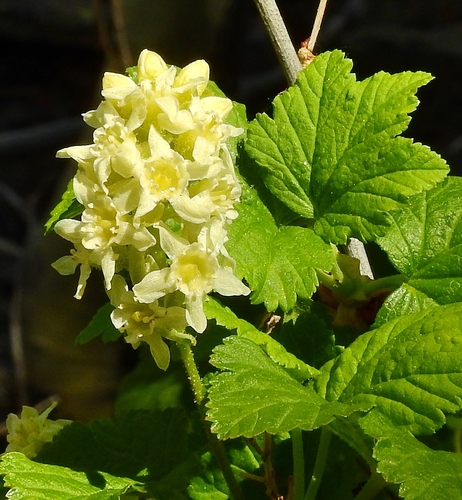
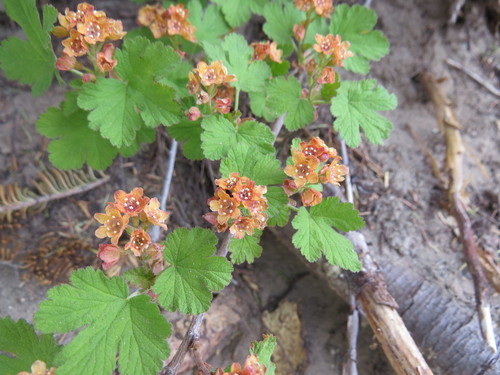
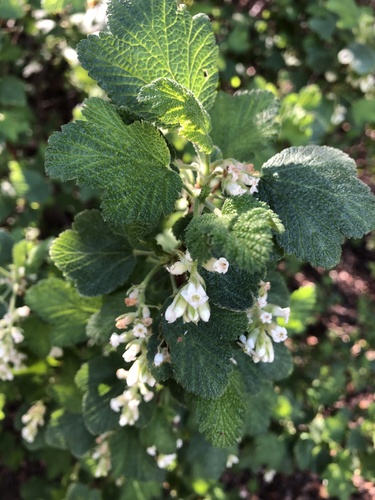
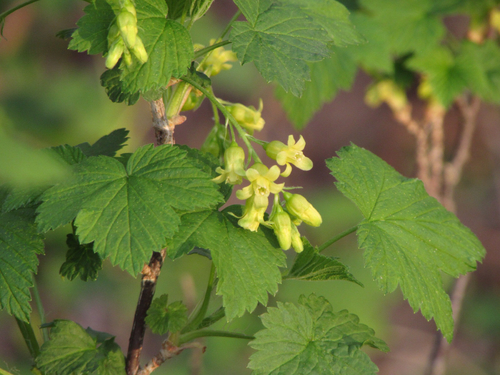
Ribes americanum Mill. is a deciduous shrub that reaches 0.5 to 1.5 meters (20 to 60 inches) in height. It has erect, spineless branches, and the plant often forms thickets. Its glandular leaves, which are 3 to 5 lobed, measure up to 7–8 cm long, and turn red and gold during autumn. The inflorescence is a spreading or drooping raceme that holds up to 15 flowers. Each flower has reflexed white or greenish sepals a few millimeters long, plus smaller whitish petals. The fruit is a smooth, round black berry around 1 centimeter (0.4 inch) wide, and it is edible when cooked. This species reproduces mostly by seed. This shrub is native to the United States and Canada, where it grows in a wide range of ecosystems. It can be found in many forest types, conifer bogs, marshes in Manitoba, and abundant sedge meadows dominated by Carex spp. in the Great Lakes region. It grows on plains, in mountains, and sometimes in disturbed areas like roadsides. It is shade-tolerant, and can grow in the understory of closed-canopy woodlands and forests. It has also been introduced to northern China. Several bee species visit the flowers of this plant: Augochlora pura, Augochlorella aurata, Ceratina calcarata, Ceratina dupla, and Ceratina strenua. This Ribes is an alternate host for Cronartium ribicola, the organism that causes white pine blister rust, a pine tree disease. It is sometimes deliberately removed to help control the spread of this rust. Puccinia caricina, the fungus that causes cluster cup rust, forms aecia on the leaves of Ribes americanum in spring, and later develops brown blotched pustules. The telia stage of this fungus forms on sedges (Carex). Native Americans made pemmican from the berries of this plant, and the berries are also commonly used to make jam and jelly.