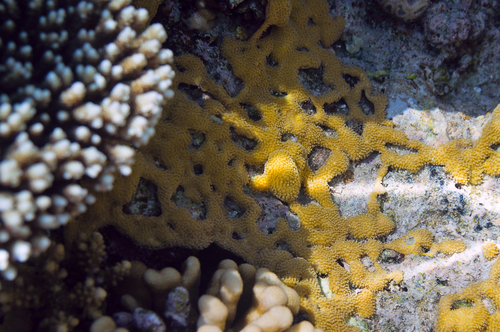
About Rhytisma fulvum (Forskål, 1775)
Rhytisma fulvum is a zooxanthellate soft coral species that has two distinct colour morphs: yellowish-brown and grey. There is no taxonomic difference between these two forms. It is an encrusting species that forms sheets over the substrate, and these sheets may mesh together. Its polyps are small, packed together in rows, and each is raised on a cone-shaped peduncle. Rhytisma fulvum is native to the Indo-Pacific region. Its range extends from the Red Sea, Zanzibar and Madagascar, to Indonesia, Papua New Guinea and the Great Barrier Reef in Australia. It grows on reefs at depths between 3 and 40 m (10 and 131 ft). It is a pioneering species, and is one of the first species to colonise areas where corals have died or reefs have been damaged. Rhytisma fulvum is a dioecious species, meaning each colony is either male or female. In the Red Sea, breeding occurs from late June to early August. By the start of the breeding season, oocytes have been maturing for about ten months, and sperm sacs have been maturing for seven months. Male colonies release sperm into the water column in a spawning event synchronized with the moon's phase, and shallow-water colonies spawn earlier in the year than deep-water colonies. Fertilization takes place inside the polyp cavities of female colonies. Embryos are then brooded on the surface of the colony, entangled in sticky mucus. After approximately six days, fully developed planula larvae are released and soon settle on the seabed. Each polyp in a female colony produces around twenty eggs, a relatively low number, but the brooding process compensates for this by maximizing the chance that developing larvae avoid predation. In the Red Sea, this soft coral is often preyed on by the nudibranch Marionia levis. The appearance of this seaslug closely resembles the surface of the coral, and its gills even mimic the coral's feeding polyps, making it very well-camouflaged. Its presence is revealed when the coral is touched: touching causes the coral's polyps to retract, exposing the nudibranch. Around a quarter of the R. fulvum corals investigated have been found to host this nudibranch.

