About Rhytidosporum procumbens (Hook.) F.Muell.
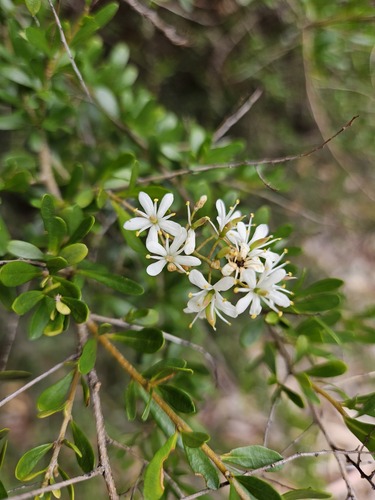
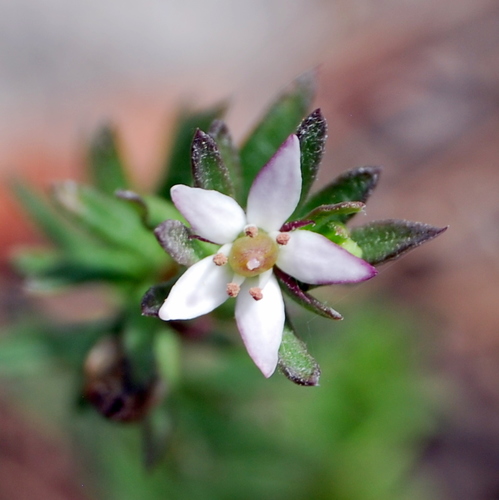
Rhytidosporum procumbens (Hook.) F.Muell. is a dwarf shrub that grows in an erect to prostrate form, reaching roughly 40 centimeters in height. When young, its stems are finely covered in short soft hairs; as they mature, they become hairless and develop multiple branches. Its leaves have no stalks, end in pointed tips, and are arranged either alternately or in clusters on stems. Leaves typically measure 5 to 20 millimeters long and 1 to 3.5 millimeters wide. Leaf margins may be smooth or have three teeth, lie flat or curve slightly downward, and are often thickened near the lower abaxial surface of the leaf. Leaf surfaces can range from hairless to covered in a fine, dense layer of short hairs. Flowers of this species have 5 to 6 separate petals, each 3 to 8 millimeters long. Petals are most often white, though the tips of the corolla and the sepals may be pale pink or purple. The outer surfaces of petals can also appear mauve, pink, or red. Flowers grow singly or in small clusters of 2 or 3, borne on floral stalks that are 2 to 15 millimeters long. After petals fall away, the floral stalks elongate and curve downward. The entire genus Rhytidosporum is native and endemic to Australia, and Rhytidosporum procumbens itself is mostly restricted to southeastern Australia. It occurs most commonly in New South Wales, Victoria, and Tasmania, with occasional recorded populations in Queensland and South Australia. This species grows most often in forest, woodland, heath, and scrubland habitats, primarily within the subtropical biome. It grows best in well-drained sandy or stony soils in lowland forests and woodlands, in locations that receive full sun or partial shade.