About Rhytidoponera metallica (Smith, 1858)
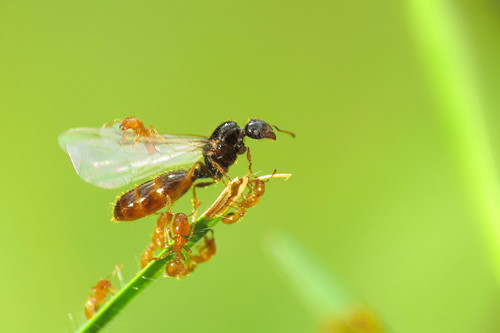
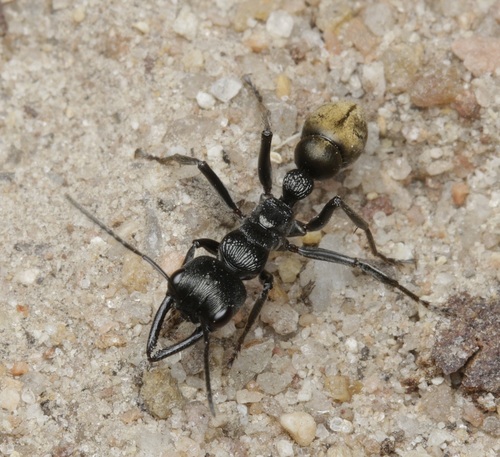
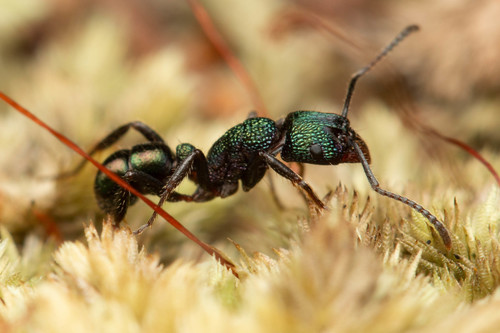
Green-head ants (Rhytidoponera metallica) are generally monomorphic, meaning all individuals belong to a single body form. Workers measure 5 to 7 mm (0.20 to 0.28 in) in length, with body colour ranging from green-blue to green-purple. They have hard, heavily armoured exoskeletons and a single-segmented waist. Queens measure 7.4 mm (0.29 in) long; their head, thorax, and abdomen display a variety of metallic colours. The queen's head is typically green behind the eyes and rust-coloured (ferruginous) at the front, with a faint purple tint between these colour zones. Queens have ferruginous antennae and egg-shaped (ovate) eyes. Viewed from the posterior, the queen's head has a notched edge (emarginate) and a wrinkled (rugose) texture; the head, thorax, and node (the segment between the mesosoma and gaster) are all rugose and covered in large, confluent punctures. The basal segment of the abdomen bears transversely curved grooves called striae. The queen's thorax is usually greenish; its wings have a glassy, semi-transparent (subhyaline) appearance, and the wing veins are brick-red (testaceous). The legs and abdomen apex are ferruginous, and the abdomen is purple. Workers and queens closely resemble one another, making the two castes hard to tell apart. Workers can be distinguished by their compressed, elongated thorax and a predominantly green-tinted abdomen. Workers are also slightly smaller than queens, averaging 6 mm (0.24 in) in length. Males are smaller than both workers and queens, measuring 5.5 mm (0.22 in) long. They are black and dark brown (fuscous), with a fuscous tarsus and rugose mandibles. Compared to workers and queens, males have shorter funicular joints, denser sculpture on the head and thorax, fewer punctures, and a coarser postpetiole. The first segment of the gaster is transversely roughened, and the hair (pilosity) on the legs is less dense. The male genitalia matches the typical form seen in other formicids, made up of an outer, middle, and inner pair of valves. The predominant body colour is metallic green, though overall body colour varies by geographic region, ranging from metallic green to purple. In the Flinders Ranges of South Australia and Alice Springs, the ants shift from the typical green to dark purple. In wetter areas such as the New South Wales tablelands and Victorian savannahs, green-head ants are mostly green, with purplish tints on the sides of the mesosoma. In northern New South Wales and Queensland, the alitrunk is reddish-violet, fading to golden around the lower portions of the pleura; in this region, green colour is either limited or completely absent. Most populations have a bright green gaster, except for populations living in the central desert. In some areas examined near Brisbane, two different colour forms were found within a single colony. It has been hypothesized that these two colour forms may represent two sibling species, but this cannot be confirmed due to lack of evidence. In far north Queensland, populations are dull green and differ from southern populations. It is unknown how far northern and southern populations interact in the western and southern regions of the Atherton Tableland, so it is currently unclear if far north Queensland populations are a separate species. In addition to colour variation, populations also show morphological differences: the size and shape of the head and petiole, the length of the appendages, and other body sculptural details can all vary across populations. Sub-mature larvae of Rhytidoponera metallica measure 4.4 mm (0.17 in) long and are similar in appearance to sub-mature larvae of Rhytidoponera cristata. They can be distinguished by their less swollen abdomen and shorter body hairs, which measure 0.096 to 0.15 mm (0.0038 to 0.0059 in). Hairs on the thorax and abdomen somite measure 0.2 mm (0.0079 in). Hairs on the flagelliform and ventral portion of the abdominal somites measure 0.075 to 0.15 mm (0.0030 to 0.0059 in). The hairs on the larval head have short denticles, and the antennae bear three apical sensilla, each containing a somewhat bulky spinule. Young larvae are much smaller than sub-mature larvae, at 1.5 mm (0.059 in) long. They resemble sub-mature larvae, but their diameter gradually decreases from the fifth somite to the anterior end. Their hairs measure 0.02 to 0.18 mm (0.00079 to 0.00709 in); the longest hairs are found on the flagelliform and all somites, but hairs on the somites become sparse. Hairs on the head have tips that are either simple or frayed, and head hairs measure 0.02 to 0.076 mm (0.00079 to 0.00299 in) in length. Both antennae have a subcone and three apical sensilla that resemble a spinule. The mandibles are sub-triangular with a curved apex. The apical and subapical teeth are sharp and short, while the proximal tooth is blunt. Unlike mature larvae, the proximal tooth of young larvae is not divided into two portions. The green-head ant is one of the most widespread endemic insects of Australia. It occurs across Victoria, New South Wales, the Australian Capital Territory, and South Australia. It can be found across most of Western Australia, though it is less common in the north. It is also present in the lower regions of the Northern Territory and east of Queensland. It is not found in Tasmania. This ant is an introduced species in New Zealand, where it was first recorded in 1959. It was probably introduced to New Zealand via timber cargo, alongside several other Rhytidoponera species. Established populations exist in Napier, where ants were collected between 2001 and 2003. Nests were previously recorded in the Auckland suburb of Penrose and in Mount Maunganui, but no specimens have been collected from these sites since the 1960s. Green-head ants occupy a wide variety of habitats, including desert, heath, open forests, urban areas, and woodland. They mainly live in moderate wooded or open areas, and are abundant in urban lawns and gardens. Nests have been recorded in dry and wet sclerophyll woodland, mallee, savannah woodland, on roadsides, and in native vegetation. Most green-head ant populations are found at altitudes between 5 and 1,000 m (16 and 3,281 ft) above sea level. Workers build small, loosely integrated nests underground, in decaying wooden stumps, or in the termite mounds of Amitermes laurensis. Nests are commonly found beneath grass roots, under logs, stones, or twigs, or at the base of shrubs. Green-head ants can nest in disturbed areas, so their colonies are common in urban areas. They are among the first insects to forage for food in areas after bushfires, and will sometimes return as soon as embers stop smouldering. Light showers in continuous sunshine do not threaten the ants. Colonies vary in their preferred nest location: for example, some colonies avoid nesting under small rocks and prefer larger ones, which seem to promote colony growth. Increased colony growth correlates with larger territory size, border disputes, more alates (fertile females and males), higher colony survival, and stable worker production. Colony growth under smaller rocks is slower and more restricted, as larger colonies need more space to accommodate extra brood and workers. Despite this preference for larger rocks, green-head ants do not select rocks based on thickness or temperature. Instead, they choose a rock based on its ground cover dimensions. The distance of a potential new rock nesting site also matters: colonies will not move more than 3 metres (9.8 ft) to reach a preferred rock. This suggests the energy cost of moving to a suitable nesting site outweighs the benefits of moving to a larger rock. Moving requires a large energy expenditure: scouts must locate a suitable site, brood must be transported safely, and the entire colony faces an increased risk of predation during the move. Nest abandonment rates vary, but peak during summer. Like other temperate species, colony activity drops greatly during colder months, which may explain the higher rate of abandonment in summer. Nest abandonment is unlikely to be caused by invasion by other species, as other species rarely invade nests abandoned by green-head ants. Structural breakdown of the nest and competition with neighbouring colonies are also unlikely causes, though seasonal changes to food sources and food competition may be contributing factors. Male green-head ants are produced irregularly throughout the year and are low-flying. Recorded nuptial flights occur between September and November, when air temperatures reach 20–25 °C (68–77 °F), and a number of males emerge from the nest. Sometimes males return to the nest after a brief period outside. Rhytidoponera metallica is a gamergate species, meaning males can successfully mate with workers. Mating workers stay outside the nest with their head and thorax pressed flat and their gaster held elevated in the air. When workers and males first encounter each other, workers typically attack the males first, after which the male mounts the worker, grasps the cervical region with its mandibles, and successfully attaches. Both ants usually rest during copulation, but sometimes workers groom themselves or move a short time after copulation starts, disengagement from the male. On rare occasions, workers begin moving as soon as copulation starts, dragging the male and eventually dislodging him. Copulation usually takes place between 8 and 9 in the morning; mating pairs stay together for 30 seconds to almost one minute. Most pairs mate once, but some mate twice. In some cases, a male will successfully mate with two workers, and some pairs return to the nest while still mating. Virgin queens are very rare in this species; some nests occasionally produce winged females. Queens are able to establish their own colonies in captivity, but wild queens have never been observed founding new colonies, suggesting the species is losing its queen caste. Most observations confirm that males mate with workers rather than queens. This loss of the queen caste is further supported by the species' apparent evolutionary transition: queens are now a rare morphological form with little importance, and workers have mostly replaced queens and taken on the reproductive role. Queens still participate in nuptial flight, and some have been observed mating with males. Queens release a sex pheromone from the pygidial gland, an exocrine gland located between the last two abdominal segments. Ergatoid (wingless reproductive) queens emerge from the nest, and like mating workers, press their head against the ground and elevate their gaster, which extends the intersegmental membrane at the back of the abdomen. The queens then release sex pheromones that attract males, which search frantically for queens via agitated movement. Males may attempt to copulate with workers that have not released a calling pheromone, which suggests workers may also be able to release these pheromones. When a male makes contact with a queen, he touches her with his antennae and grasps the female's thorax with his mandibles. A queen signals she is ready to mate by turning her abdomen to the side, and the male locates the genitalia with his copulatory apparatus. Mating pairs may copulate for several minutes. Most colony founding is initiated by a fertilized worker that establishes herself in a closed cell, and she sometimes leaves the cell to forage for food. Observations show that most workers founding new colonies follow the typical behaviour of Ponerine ants, laying eggs and rearing their larvae. However, in captive colonies founded by workers, only male brood emerge. This suggests new colonies are probably formed when multiple workers leave their parent nest, a few of which are fertilized. This process is called budding, also referred to as "satelliting" or "fractionating", where a subset of the colony leaves the main colony for an alternative nest site. This may not be the only method of colony founding, as some queens can establish their own colonies. Inseminated queens can successfully found a colony in non-claustral, haplometrotic conditions (founded by a single queen that hunts for food to feed her young), but colony growth immediately after founding is very slow, unlike other Rhytidoponera species which grow faster. There is a clear division of labour between queens and workers. When a queen dies, workers may sometimes compete and display sexual calling behaviour, confirming workers can reproduce in queenless nests. Despite the near-absence of queens, long-range dispersal via winged queens may still occur. New colonies start small but can expand rapidly until they reach maturity. Genetic patterns indicate that green-head ant workers mate with unrelated males from distant colonies. Relatedness among workers is very low, and gamergate ants make up a high proportion of the colony. If all gamergates in a nest are unrelated, a single nest can hold as many as nine gamergates, and all of these contribute to producing young. The average number of gamergates can still be high even if they are related and each has a larger share of reproduction. Most of the time, gamergates are generally unrelated, and shared relatedness among gamergates is uncommon. In many colonies, workers and gamergates prevent young females from reproducing through policing. The increased intra-colony genetic variance resulting from low kinship is thought to provide a selective advantage by expanding the pharmacological repertoire of the ant's venom.