About Rhytidiadelphus squarrosus (Hedw.) Warnst.
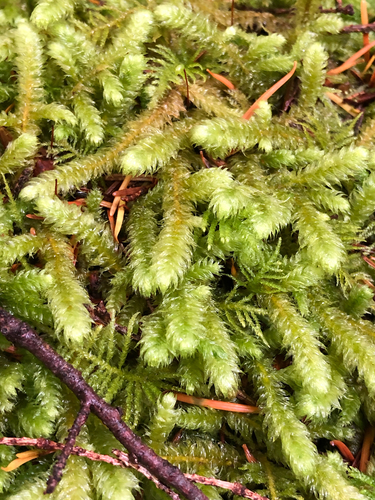
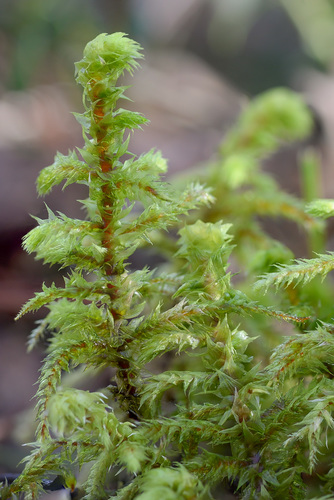
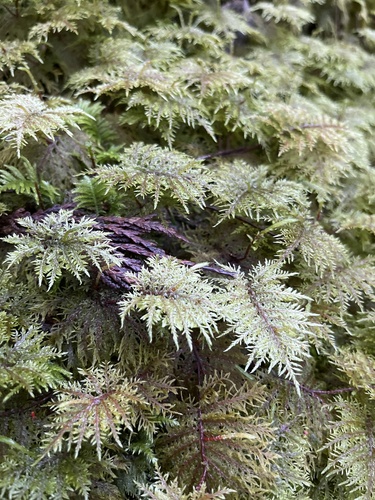
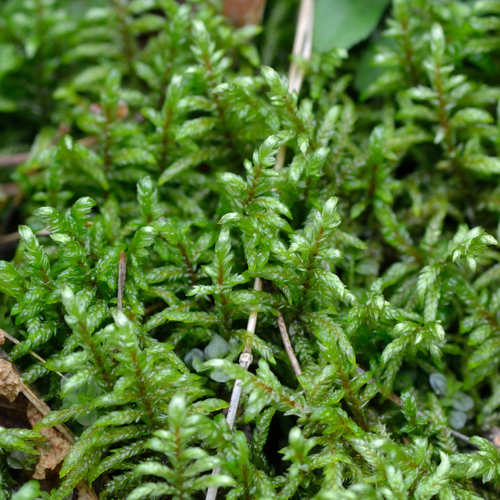
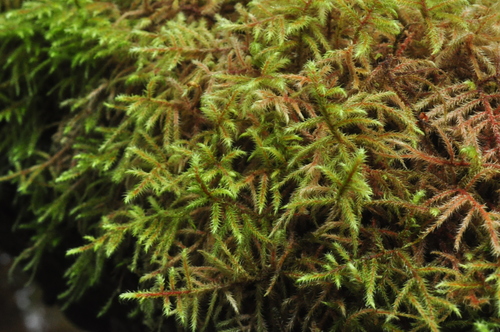
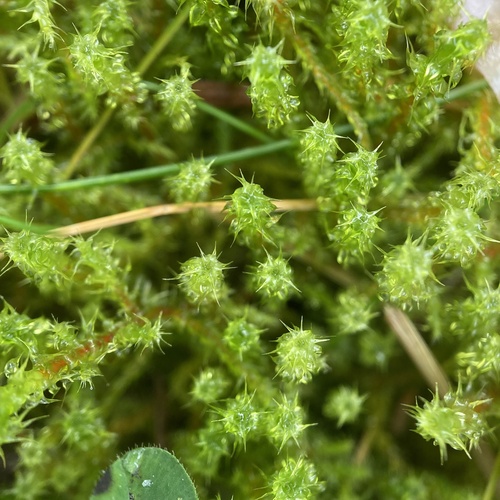
Rhytidiadelphus squarrosus grows as an extensive mat of branching stems, reaching up to 15 centimetres (6 in) tall. Its stems are sheathed in 2–2.5 mm (0.08–0.10 in) long leaves that bend sharply back at a right angle, spreading outwards from the stem. Leaf bases are broad and contain a pair of short nerves. This species rarely produces capsules, so most of its reproduction is asexual.
Rhytidiadelphus squarrosus has a circumpolar distribution across the Northern Hemisphere. It occurs across much of Eurasia, and in parts of North America including British Columbia, Alaska, Washington, Oregon, Newfoundland and Labrador, and Greenland. It has also been introduced to northeastern North America, Tasmania, and New Zealand, where it is now an invasive species. The first specimen collected in the Southern Hemisphere was gathered in 1974 at Dundas Creek, western Tasmania, while the first published record of the species in the region came the following year, from a golf course in Dunedin on New Zealand's South Island.
Ecologically, R. squarrosus tolerates a wide range of soil conditions, from calcareous grassland to acid heaths. It grows most noticeably in heavily grazed pastures and on regularly mown golf course fairways, and is the most common moss found in lawns across the United Kingdom. It is almost always found growing in association with human activity, so its original natural habitat remains unclear; it may have evolved as a native plant of coastal meadows.