About Rhyticeros undulatus (Shaw, 1812)
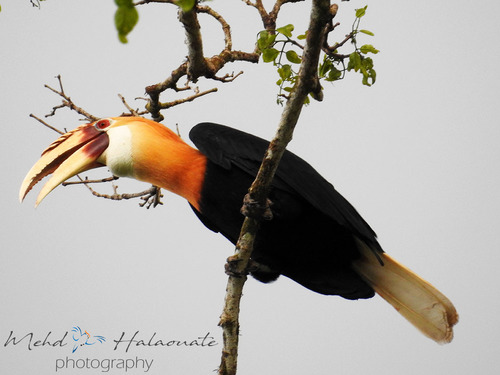
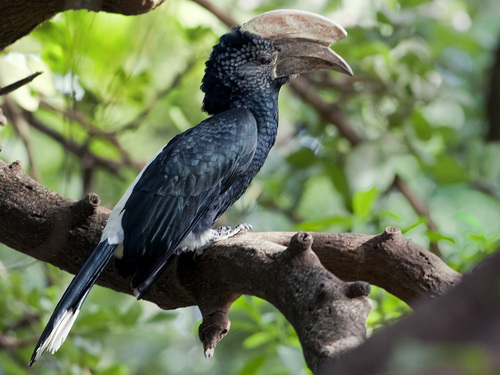
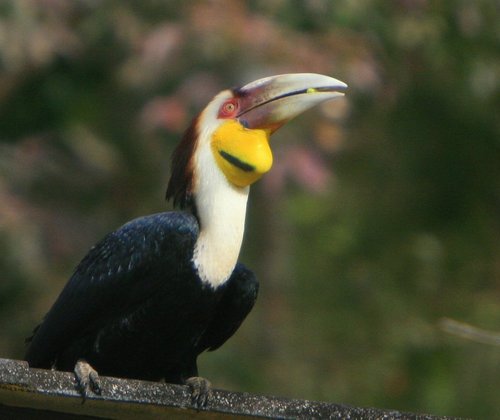
Rhyticeros undulatus (Shaw, 1812), commonly called the wreathed hornbill, has distinct plumage and physical traits. Its body is mostly black, with black legs and feet, a pale yellow bill, bare reddish skin surrounding the eyes, a black band across the gular skin, and a white tail. The color of the gular skin differs between sexes: females have blue gular skin, while males have bright yellow gular skin. Males also have a white neck and a dark reddish nape that transitions into black. Sexual dimorphism in plumage and inflatable gular skin color is less distinct in young wreathed hornbills, and becomes more visible as both sexes mature. This is a medium-sized bird, with a total body length between 75 and 90 cm (30 to 35 in). Adult males weigh 1.68 to 3.65 kg (3.7 to 8.0 lb), while adult females weigh 1.36 to 2.69 kg (3.0 to 5.9 lb).
All hornbill species belong to a family distinguished by their large, heavy bills that bear characteristic casques, a trait that sets them apart from other bird groups. Hornbill casques have foamy, air-filled cavities surrounded by multiple layers of keratin tiles that form an outer shell. The first two vertebrae are fused to support the extra weight of the casque. The wreathed hornbill has a distinctive serrated casque with ridges near the base of its upper mandible, a unique feature for this species. As the bird matures, forward growth of the casque causes the foremost ridge to break off. Researchers hypothesize that this species' specialized casque traits evolved in response to multiple selection pressures, including use for enhancing vocalizations, physical pounding, mating displays, and acting as a visual cue for age and social status.
The wreathed hornbill lives in tropical evergreen forests, ranging from southern Bhutan, Northeast India, and Bangladesh, through mainland Southeast Asia, to Indonesia, where it is only found on Sumatra, Java, Borneo, and a few smaller islands. It has been recorded at elevations up to 2,560 m (8,400 ft). In Sarpang district, Bhutan, two individuals were spotted in spring 1986. In Northeast India, it inhabits unlogged primary forests and selectively logged forests in the Eastern Himalayan foothills, stretching from Nameri National Park in Assam to Namdapha National Park in Arunachal Pradesh. It stays in lowland areas during the breeding season, and moves to higher elevations during the non-breeding season. In Myanmar, 62 wreathed hornbills were seen in the Mali River valley at elevations of 800–2,500 m (2,600–8,200 ft) in winter 1999. A flock of around 50 individuals was spotted in Hponkanrazi Wildlife Sanctuary in September 2004.
This is a social species that is most active in early mornings while foraging for fruit. A study of 21 individuals in Pakke Tiger Reserve during the non-breeding season found the birds rested at midday and resumed foraging activity in early afternoons. It forms larger flocks than other hornbill species, and stays in groups during both the breeding and non-breeding seasons. Flock size observed at Namdapha National Park had a mean of 4.7 to 6.6 individuals, with bird density ranging from 1.3 birds/km² (3.4 birds/sq mi) in March and April to 68 birds/km² (180 birds/sq mi) in December. In Arunachal Pradesh, wreathed hornbill density is far lower in habitats hunted by local people, ranging from 2.9 to 9.02 birds/km² (7.5 to 23.4 birds/sq mi). It travels long distances to forage for fruit, and sometimes flies between islands, but it does not migrate. A male wreathed hornbill fitted with a GPS tracking unit in Pakke Tiger Reserve during breeding season moved a mean minimum daily distance of 24.8 km (15.4 mi), and dispersed seeds up to 10.8 km (6.7 mi) away from its nesting site. The home ranges of wreathed hornbills and other hornbill species overlap in multiple countries across this species' range.
Wreathed hornbills are monogamous breeders that practice biparental care. They nest in cavities of large trees, which can be located in coastal forests, illegally logged areas, or foothills up to 2,560 m (8,400 ft) in elevation. They cannot excavate their own nest cavities, so they search for existing oval-shaped tree hollows to use for nesting. Nest height ranges from 18 to 28 m (59 to 92 ft) above the ground. Female wreathed hornbills use droppings or mud to cover the nest hole opening, to protect their clutch and fledglings from predators. They leave a gap just large enough for the male to deliver food through, and remove the mud when they need to leave the nest. The average clutch size is 1 to 3 eggs. The female alone incubates and guards the eggs for 40 days. She only raises one of the hatched chicks, and stays inside the nest with the chick until it fledges at the end of the nesting cycle, which lasts 111–137 days. Both parents stay with the juvenile for multiple months after it leaves the nest.