About Rhynchopsitta pachyrhyncha (Swainson, 1827)
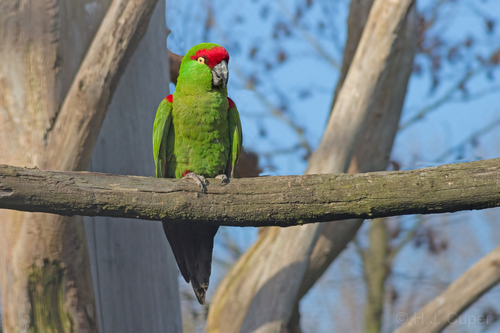
The thick-billed parrot (Rhynchopsitta pachyrhyncha) is a medium-sized parrot. It is primarily bright green, with a large black bill, and red markings on its forecrown, shoulders, and thighs. Adult thick-billed parrots have amber-colored eyes, while juveniles have brown eyes. Their underwings have a red leading edge, followed by a blackish-green stripe, a yellow stripe, and dark green on the rest of the underwing. The tail is black. This species measures 38 cm (15 in) long and weighs between 315–370 g (11.1–13.1 oz). Thick-billed parrots can live up to 33 years in captivity. It resembles the larger military macaw (Ara militaris), which has a proportionally longer tail, blue flight feathers, and a blue rump, as well as the lilac-crowned amazon (Amazona finschi). Note that these similar species are not the thick-billed parrot's closest phylogenetic relatives, which are discussed in Taxonomy. The thick-billed parrot's voice is high-pitched and similar to a macaw's, made up of various harsh, rolling calls that have been compared to human laughter. While the species can become easily hand-tame, it is nervous, difficult to breed in captivity, and has very low reproduction rates. Captive thick-billed parrots are moderate voice mimics, capable of learning a few words and phrases. However, their piercing calls and relatively less bright coloration have kept them from being popular in the pet trade, and there is currently little demand for them, whether captive-bred or illegally caught from the wild. Like other parrots, thick-billed parrots manipulate food by holding it with one foot. They are highly social: they may share food stored in their crop (a pouch located in the throat) with other group members, and spend free time preening each other. Historical records note groups of over 1,000 thick-billed parrots gathering in a single location. The thick-billed parrot inhabits temperate conifer forests, pine forests, mature pine-oak forests, and fir forests at elevations between 1200 and 3600 meters. It is mostly restricted to the Sierra Madre Occidental in the Mexican states of Chihuahua and Durango. Its former range included the southwestern United States, specifically Arizona and New Mexico. Early records also place the species in far west Texas—ornithologist John James Audubon sighted thick-billed parrots in El Paso in 1827—and possibly as far north as Utah. Records from Arizona and New Mexico note that the birds visited these areas regularly, and over-wintered in Arizona. However, heavy shooting, logging, and development coincided with these records and ultimately drove the thick-billed parrot to extirpation in the United States. European colonization disrupted traditional Native American ways of life, which greatly reduced the range of some bird species that relied on Native American irrigation and farmland; it is possible that the thick-billed parrot was also negatively affected by this change. After the extinction of the Carolina parakeet (Conuropsis carolinensis) and the extirpation of the thick-billed parrot, the green parakeet (Psittacara holochlorus) is now the only extant native parrot species in the United States. The last confirmed sightings of thick-billed parrots in the southwestern United States were in 1935 and 1938 in Arizona's Chiricahua Mountains.